

Astrolab to Carry NASA Science Payloads on Future Moon Mission
Astrolab, an aerospace company focused on the development of advanced planetary rovers and surface mobility systems, has announced a set of NASA payload customers for its upcoming lunar mission aboard its FLIP (FLEX Lunar Innovation Platform) rover. The mission represents a significant step forward for both commercial lunar exploration and NASA’s broader Artemis program, which aims to establish a sustainable human presence on the Moon.
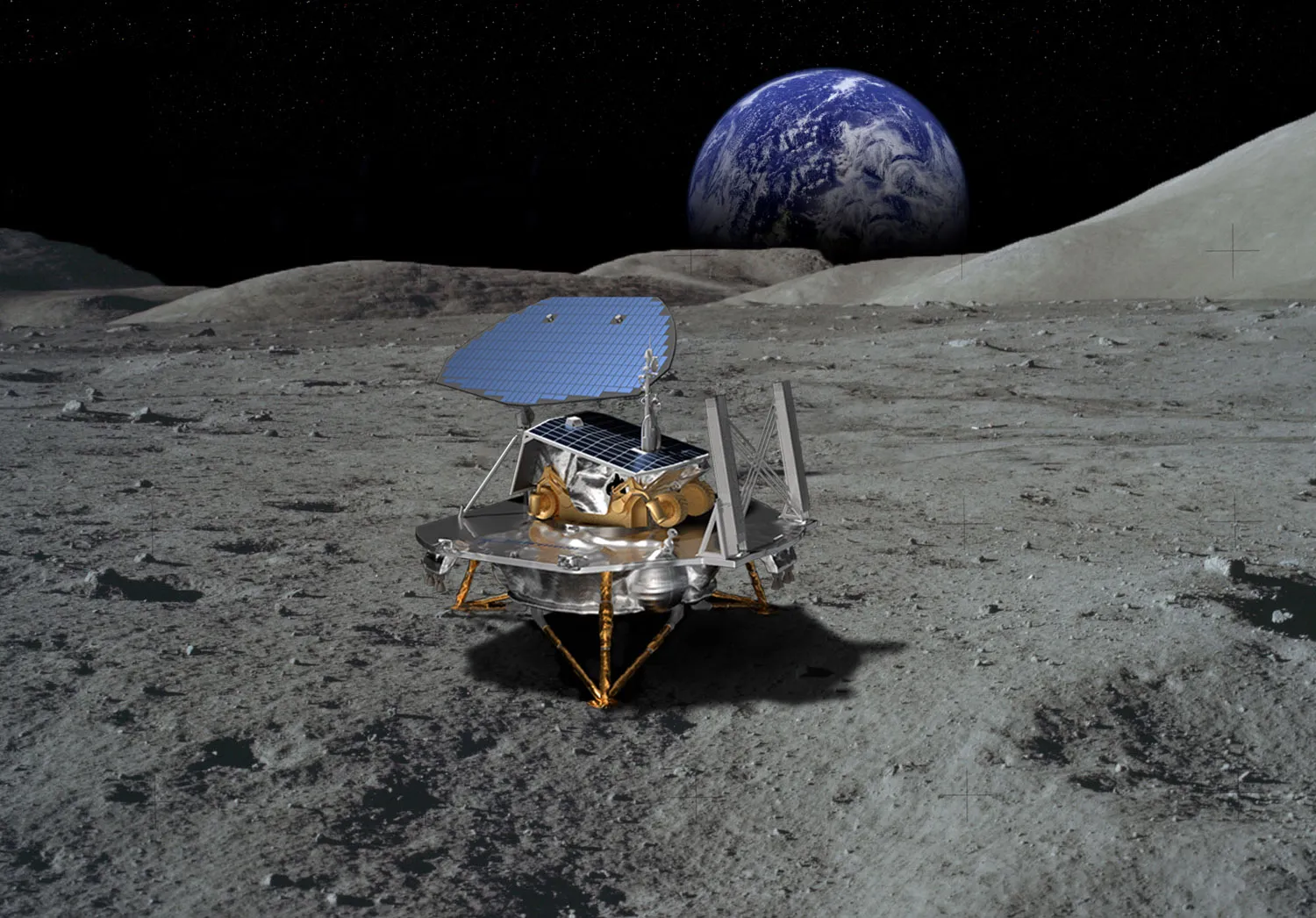
The FLIP rover will be delivered to the lunar surface aboard Astrobotic’s Griffin-1 lander as part of NASA’s Commercial Lunar Payload Services (CLPS) initiative. CLPS is designed to leverage private-sector capabilities to deliver scientific instruments, technology demonstrations, and other payloads to the Moon more efficiently and at lower cost than traditional government-led missions. The Griffin-1 mission is specifically targeted to land at the Moon’s south pole, a region of high scientific interest due to its permanently shadowed craters and potential water ice deposits.
The mission is currently scheduled for launch in late 2026, although timelines for lunar missions remain subject to change based on technical readiness and launch availability. Astrolab also noted that additional commercial payload customers are expected to be announced in the coming months, suggesting that the FLIP rover will carry a broader mix of scientific and commercial experiments beyond the currently disclosed NASA instruments.
FLIP Rover’s Role in Lunar Surface Operations
FLIP, short for FLEX Lunar Innovation Platform, is designed as a compact and highly adaptable rover intended to support small payload delivery and autonomous mobility operations on the lunar surface. Unlike larger rover systems that focus on extended surface traversal and heavy payload transport, FLIP is optimized for agility, modularity, and multi-mission support. Its role in this mission is to serve as a testbed for both scientific payload deployment and advanced mobility capabilities in the challenging environment of the Moon.
The upcoming mission will mark FLIP’s first operational deployment to the lunar surface. During this mission, the rover will carry and operate instruments developed by multiple NASA centers, while also collecting engineering and performance data. This data is expected to play a critical role in refining future lunar mobility systems, particularly those intended to support NASA’s Artemis astronauts during surface exploration missions later this decade.
Astrolab has emphasized that FLIP is not only a delivery platform but also a technology demonstrator. By integrating multiple payloads from different institutions into a single rover-based mission, the company aims to showcase how small, mobile platforms can enhance the scientific return of lunar exploration efforts while reducing cost and complexity.
NASA Payloads Selected for the Mission
The FLIP rover will carry a diverse suite of instruments developed across several NASA centers, each targeting distinct scientific and engineering objectives. These payloads are designed to advance lunar science, resource identification, surface navigation, and environmental characterization.
NASA Ames Research Center — METAL Instrument
One of the primary payloads is the Moon Exploration for Titanium with Active Lighting (METAL) instrument developed by NASA’s Ames Research Center in collaboration with Interlune, a company focused on space-based natural resource development. METAL is a multicolor camera and radiometer system designed to assess the composition of lunar regolith, with a particular focus on estimating the presence of helium-3.
Helium-3 is a rare isotope that has attracted interest due to its potential applications in future energy systems, including theoretical fusion power. Although its economic viability remains uncertain, it is considered an important target for long-term lunar resource studies. METAL will use optical and radiometric measurements to analyze surface materials, helping scientists refine models of lunar resource distribution and better understand the Moon’s geologic history.
By providing in-situ data from the lunar surface, METAL is expected to contribute to a broader understanding of how titanium-bearing minerals and other materials are distributed across the Moon, particularly in the south polar region.
NASA Goddard Space Flight Center — Laser Retroreflector Array (LRA)
Another key payload is the Laser Retroreflector Array (LRA) developed by NASA’s Goddard Space Flight Center. This instrument will be the first of its kind mounted on a lunar rover, enabling highly precise tracking of the rover’s location using laser beams fired from orbiting spacecraft.
The LRA consists of eight quartz corner-cube prisms embedded within a dome-shaped aluminum structure. It is entirely passive, requiring no electrical power or maintenance to function. When illuminated by laser pulses from an orbital laser altimeter, the array reflects the light back to its source, allowing extremely accurate measurements of distance and position.
This capability is particularly important for lunar navigation and mapping. Once FLIP completes its mission, the LRA will remain on the lunar surface as a permanent geolocation reference point. Future missions can use it as a fixed marker for calibration, landing precision, and surface navigation, making it a valuable long-term asset for lunar exploration infrastructure.
NASA Johnson Space Center — Lunar Dust Effects Sensor (LDES)
The Lunar Dust Level Sensor and Effects on Surfaces (LDES), developed by NASA’s Johnson Space Center, will study one of the most persistent challenges in lunar exploration: dust. Lunar regolith is extremely fine, abrasive, and electrostatically charged, allowing it to cling to surfaces and interfere with mechanical systems, thermal control, and energy generation.
LDES is designed to quantify how lunar dust affects key spacecraft and surface systems, including radiators, solar panels, and structural components. By measuring dust accumulation and its impact on thermal performance, the instrument will provide critical data on how lunar environments degrade hardware over time.
The findings from LDES are expected to support the design of future lunar infrastructure, including habitats, landers, and long-duration surface assets. Understanding dust behavior is considered essential for ensuring the reliability and survivability of Artemis base systems and other extended lunar operations.
NASA Marshall Space Flight Center — Lunar LiDAR Demonstration
The fourth major payload comes from NASA’s Marshall Space Flight Center and consists of a hardened Light Detection and Ranging (LiDAR) system designed for lunar conditions. This system will generate high-resolution three-dimensional maps of the surrounding terrain, enabling precise navigation and hazard detection.
LiDAR technology is widely used on Earth for mapping and autonomous vehicle navigation, but adapting it for the Moon requires significant engineering modifications due to extreme temperatures, radiation exposure, and lighting conditions. On FLIP, the system will help identify obstacles, map surface features, and support safe rover movement in unfamiliar terrain.
The data collected will be particularly valuable for future missions requiring autonomous or semi-autonomous navigation, including crewed Artemis surface operations where real-time hazard avoidance will be critical.
Statement from Astrolab Leadership
Commenting on the announcement, Jaret Matthews, founder and CEO of Astrolab, expressed pride in the company’s role in supporting NASA’s lunar exploration efforts.
He stated that the FLIP platform is designed to provide a flexible and efficient means of delivering multiple scientific investigations to the lunar surface within a single mission. According to Matthews, this approach enables a wider range of research activities while optimizing mission resources.
He further emphasized that the collaboration with NASA and other partners will help accelerate preparations for future Artemis astronaut missions, where mobility, surface data collection, and operational flexibility will be key requirements.
FLIP’s Unique Design and Mission Advantages
A distinguishing feature of the FLIP rover is its ability to operate without the need for a traditional deployment ramp. Instead, the rover is engineered to directly egress from the top of the lander once it has reached the lunar surface. This design innovation reduces mechanical complexity and minimizes potential points of failure during deployment.
By eliminating the need for ramp-based descent systems, FLIP can accommodate a wider variety of landing configurations and lander interfaces. This flexibility is particularly valuable in commercial lunar missions, where payload integration and lander compatibility are increasingly diverse.
The rover’s compact form factor also allows it to serve as a multi-purpose platform capable of hosting different payload types simultaneously. This modular approach is intended to increase mission efficiency and scientific output without requiring multiple separate rover deployments.
Supporting the Artemis Program and Future Lunar Exploration
Beyond its immediate mission objectives, FLIP is expected to contribute to the broader development of Astrolab’s larger Flexible Logistics and Exploration (FLEX) rover system. FLEX is being designed as a next-generation lunar mobility platform intended to support sustained human operations on the Moon under NASA’s Artemis program.
Data gathered from FLIP’s performance—ranging from mobility behavior and environmental interaction to payload functionality—will help inform the engineering of future systems capable of transporting astronauts, equipment, and scientific instruments across the lunar surface.
As NASA and its commercial partners move toward long-term lunar presence, systems like FLIP are seen as essential building blocks for establishing a functional and scalable lunar economy. The combination of scientific instrumentation, autonomous mobility, and commercial payload integration reflects a growing shift toward multi-use platforms in space exploration.
With its planned late-2026 launch window, the FLIP mission represents an important milestone in the evolution of commercial lunar exploration. As additional payload customers are announced and mission preparations continue, the rover is positioned to play a key role in demonstrating how compact, versatile robotic systems can support both scientific discovery and infrastructure development on the Moon.
If successful, the mission will not only deliver valuable data from the lunar south pole but also help validate new approaches to surface mobility, payload integration, and autonomous operations—capabilities that will be critical for the next era of human and robotic exploration under the Artemis program.
Source link: https://www.businesswire.com/