

Flytrex Opens Dallas Drone Manufacturing Hub to Power Expansion Toward 60 Delivery Sites by Mid-2027
Flytrex, a leading autonomous drone food delivery company, has announced the opening of a new drone manufacturing and maintenance facility in Pilot Point, Texas, marking a significant milestone in its rapid expansion strategy across the Dallas–Fort Worth (DFW) metroplex. The facility will play a central role in supporting the company’s ambition to establish 60 drone delivery sites across the region by mid-2027, strengthening its position in one of the fastest-growing urban drone delivery markets in the United States.
The new facility is designed to function as both a production and operational hub, capable of assembling thousands of drones annually. By integrating manufacturing, maintenance, testing, and deployment under one roof, Flytrex aims to streamline its supply chain and accelerate the rollout of its delivery network. The company’s expansion is further supported by high-profile partnerships with global food delivery platforms DoorDash and Uber Eats, both of which are helping integrate drone delivery into mainstream last-mile logistics.
Located in Pilot Point, the facility spans nearly 8,000 square feet and includes a secure indoor warehouse as well as a designated outdoor test flight area. It is fully equipped to handle drone assembly, ongoing servicing, and pre-deployment flight validation. This infrastructure enables Flytrex to rapidly scale operations, reduce turnaround times for drone deployment, and maintain consistent service reliability across expanding delivery zones.
At present, the facility employs around 20 local workers, including technicians, engineers, and operational staff. However, Flytrex expects the workforce to grow to approximately 50 employees as production ramps up. Once fully operational, the site is projected to support the manufacture of roughly 1,000 drones annually, aligning with the company’s broader rollout of new delivery locations throughout the DFW metroplex.
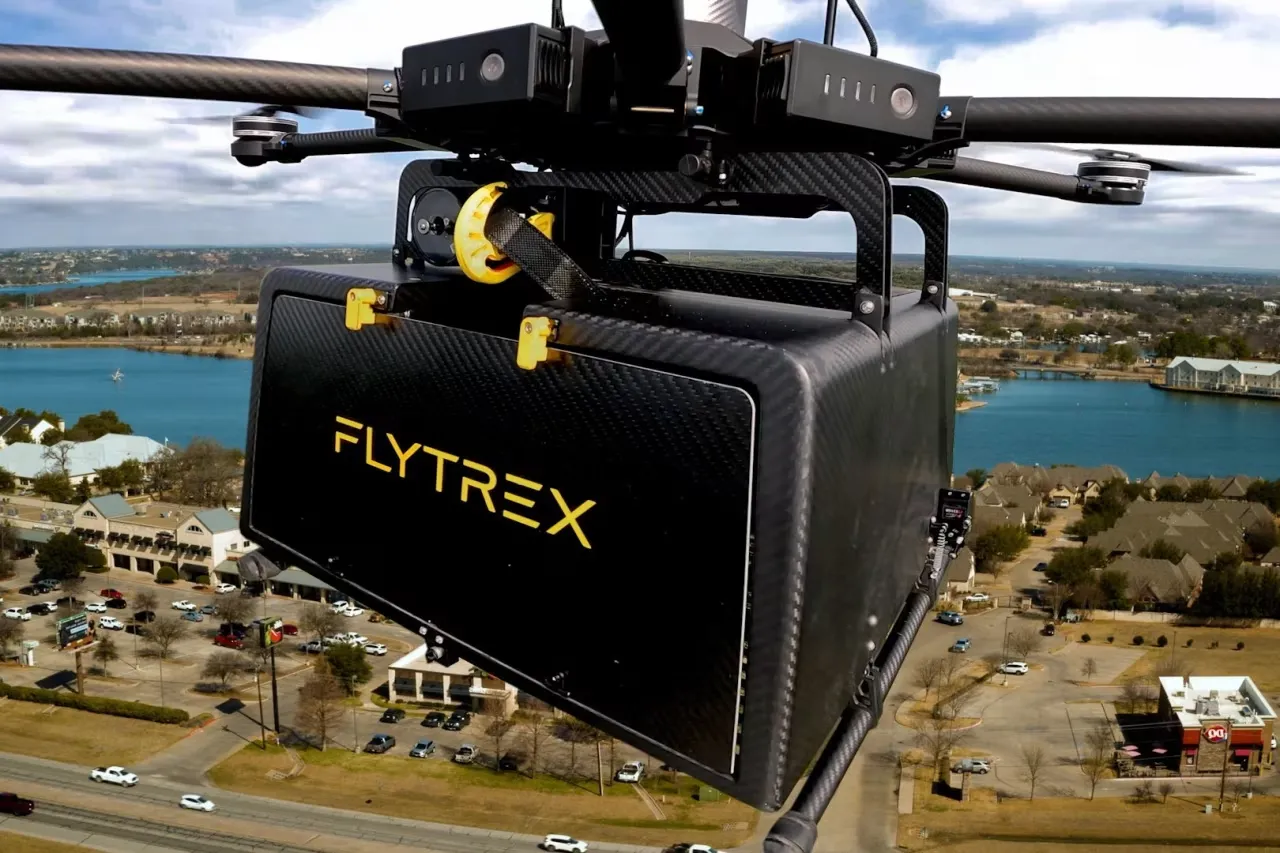
A key driver behind the establishment of the facility is Flytrex’s latest technological advancement, the Sky2 drone. Unveiled earlier this year, Sky2 represents the company’s next-generation delivery aircraft, featuring an industry-leading payload capacity of 8.8 pounds. The drone is specifically designed for food and small parcel delivery, allowing it to carry a wide range of orders commonly fulfilled by on-demand delivery platforms. The Pilot Point facility will serve as the primary assembly site for Sky2 drones deployed throughout the region.
The facility itself includes dedicated assembly lines, quality assurance stations, maintenance bays, and pre-flight testing infrastructure. This integrated approach ensures that each drone can be manufactured, tested, and certified for operational readiness within the same geographic region where it will be deployed. Flytrex believes this localized production model will significantly improve efficiency and reduce logistical complexity compared to traditional centralized manufacturing approaches used by other drone operators.
Flytrex’s decision to localize manufacturing in Texas also reflects broader shifts in U.S. policy and industry direction. In 2025, federal leadership introduced measures aimed at strengthening the domestic drone manufacturing ecosystem, including directives encouraging agencies to prioritize American-made unmanned aerial systems. This regulatory environment has accelerated investment in local production capabilities and reinforced the strategic importance of domestic aerospace innovation.
By establishing its manufacturing base within the same region where its drones operate, Flytrex is positioning itself differently from competitors that rely on out-of-state or overseas production. The company emphasizes that co-locating manufacturing and operations allows for faster iteration cycles, improved maintenance responsiveness, and stronger alignment between engineering teams and real-world operational data.
The Pilot Point facility is also a cornerstone of Flytrex’s broader expansion roadmap across the Dallas–Fort Worth metro area. The company is preparing to launch a new delivery site in Rowlett in the coming months, which will extend its service coverage to nearly 200,000 residents. Beyond this initial expansion, Flytrex plans to open an additional five to seven delivery sites across DFW during 2026 alone, laying the groundwork for a much larger network.
By mid-2027, Flytrex aims to operate approximately 60 drone delivery sites across the metroplex, a scale that would allow the company to reach an estimated five million residents. This expansion strategy reflects growing demand for faster, more efficient last-mile delivery solutions in densely populated suburban and urban regions, where traditional delivery services often face congestion and delays.
According to Flytrex Co-Founder and CEO Amit Regev, the company’s decision to invest in localized manufacturing is central to its long-term strategy. He emphasized that the Pilot Point facility is not just about increasing production capacity, but about building a sustainable and scalable operational model for the future of drone logistics.
Regev described Dallas–Fort Worth as a “proving ground” for large-scale drone delivery operations, highlighting the region’s combination of population density, geographic spread, and regulatory support as ideal conditions for testing and scaling autonomous logistics networks. He noted that Flytrex’s approach is to embed manufacturing and maintenance capabilities directly into each major market it serves, ensuring that the entire supply chain—from assembly to last-mile delivery—remains localized and responsive.
This model, according to the company, is intended to enhance operational resilience while also supporting faster expansion timelines. By reducing dependency on centralized production facilities, Flytrex can more rapidly deploy new drones, respond to maintenance needs, and adjust operations based on real-time demand patterns in each service area.
Flytrex’s growth comes amid increasing momentum in the drone delivery industry as a whole. The company is one of only a small number of U.S. operators authorized by the Federal Aviation Administration (FAA) to conduct Beyond Visual Line of Sight (BVLOS) operations, a critical capability that enables drones to fly long distances without direct visual oversight from operators. This regulatory approval places Flytrex among the most advanced commercial drone operators in the country.
In addition to its partnerships with DoorDash and Uber Eats, Flytrex has also played a pioneering role in developing shared airspace frameworks alongside Alphabet’s Wing. These frameworks allow multiple autonomous drone operators to safely coordinate flight paths within overlapping airspace zones, an essential step toward enabling high-density drone operations in urban environments.
Uber Eats’ involvement is particularly notable, as the company has made its first-ever investment in drone delivery through its partnership with Flytrex. This signals growing confidence from major logistics and food delivery platforms in the long-term viability of autonomous aerial delivery systems.
The combination of technological innovation, regulatory progress, and strategic partnerships is helping position Flytrex at the forefront of the evolving drone logistics industry. As the company continues to expand its physical infrastructure in Texas and beyond, it is also laying the groundwork for what could become one of the most extensive commercial drone delivery networks in the United States.
With its Pilot Point facility now operational, Flytrex is moving decisively toward its vision of scalable, localized drone logistics—one that blends manufacturing, testing, and real-time delivery into a unified system designed for speed, efficiency, and long-term growth.
Source link: https://www.businesswire.com/