

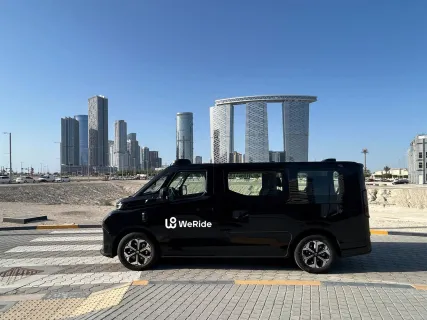
WeRide, Uber, and AVOMO Launch Robotaxi Service in Madrid: Spain’s First Commercial Autonomous Ride-Hailing Pilot Begins in the Capital
WeRide, a global leader in autonomous driving technology, and Uber Technologies, Inc. (NYSE: UBER) have announced plans to introduce Spain’s first commercial Robotaxi pilot in the Region of Madrid. The initiative marks a significant milestone for both companies as they make their first coordinated entry into the European autonomous mobility market, expanding a partnership that has already been tested in other international regions.
The planned rollout is expected to begin later this year, subject to regulatory coordination and operational readiness, and will be carried out in collaboration with the Regional Government of Madrid (Comunidad de Madrid). Once launched, Robotaxi rides will be accessible directly through the Uber app, integrating autonomous vehicle services into an existing global mobility platform already familiar to millions of users.
The launch represents not only a technological deployment but also a broader step toward scaling autonomous ride-hailing in major European cities. It reflects growing regulatory openness in parts of Europe toward pilot programs for self-driving mobility solutions, particularly in controlled commercial environments designed to prioritize safety, monitoring, and gradual scaling.
First Commercial Robotaxi Pilot in Spain
The Madrid pilot will be the first time Spain hosts a commercial Robotaxi service, positioning the country as an emerging hub for autonomous vehicle testing and deployment within Europe. Unlike experimental or closed-track testing environments, the initiative is designed as a real-world commercial service, albeit with phased deployment and operational safeguards.
At the initial stage, the fleet will include trained safety operators in the vehicles. These operators will supervise autonomous performance, ensuring smooth handling of edge cases during early deployment. Over time, as performance benchmarks and safety metrics are achieved, the partners expect to progressively scale the fleet and transition toward fully driverless commercial operations in designated urban zones.
WeRide, Uber, and AVOMO have indicated that the long-term ambition is to deploy hundreds of Robotaxis in Madrid, subject to regulatory approvals and operational milestones. This phased expansion model is intended to ensure that safety, reliability, and public acceptance remain central to the rollout strategy.
Expansion Path Toward Fully Driverless Operations
A key objective of the Madrid deployment is the eventual introduction of fully driverless Robotaxi services in core urban areas. The companies have emphasized that scaling will be performance-driven, with expansion tied to real-world operational data, system reliability, and compliance with local transport regulations.
The Madrid project is part of a broader commercial roadmap developed under the WeRide–Uber partnership, which envisions multi-city expansion across global markets. The collaboration already has operational experience in the Middle East, where WeRide-powered Robotaxi services are active in Abu Dhabi and Dubai, with additional expansion expected in Riyadh in the near future.
The experience gained in these markets has helped refine operational frameworks for autonomous mobility, including fleet management, remote monitoring systems, and safety validation protocols. These learnings are expected to be transferred into the Madrid deployment, enabling faster scaling and more efficient service optimization.
AVOMO’s Operational Role in Madrid
A key component of the Madrid launch is the involvement of AVOMO, a company within the Moove Cars Group, which will support transportation service operations in the region. AVOMO is expected to play a central role in managing fleet logistics, vehicle availability, and on-the-ground coordination to ensure smooth daily operations.
AVOMO also serves as Uber’s autonomous fleet operations partner in select U.S. cities, including Atlanta and Austin, giving it prior experience in managing mobility services that integrate advanced vehicle technologies. This operational background is expected to support the transition of Robotaxi services into the European market, where regulatory and infrastructure conditions differ from those in the United States and the Middle East.
By combining AVOMO’s operational capabilities with Uber’s ride-hailing platform and WeRide’s autonomous driving technology, the partnership aims to build a multi-layered ecosystem that supports both near-term deployment and long-term scalability.
Asset-Light Strategy and Scalable Deployment Model
WeRide’s expansion into Madrid also reflects its broader asset-light business strategy. Rather than owning and operating large vehicle fleets independently, WeRide focuses on providing autonomous driving technology and platform systems, while relying on strategic partners to contribute fleet investment, operational infrastructure, and local market expertise.
This model allows for faster geographic expansion and reduces capital intensity, enabling the company to scale across multiple markets simultaneously. In Madrid, Uber and AVOMO are expected to play significant roles in platform integration and fleet operations, while WeRide provides its autonomous driving stack and simulation systems.
At the core of this approach is the WeRide One platform, a universal autonomous driving system designed to operate across multiple vehicle types and environments. The platform is supported by the WeRide GENESIS simulation system, which enables large-scale virtual testing and scenario training for autonomous driving models. These technologies are intended to accelerate deployment timelines while maintaining rigorous safety validation standards.
Madrid as a Strategic European Entry Point
The selection of Madrid as the launch city reflects its strong position as one of Europe’s most dynamic urban mobility markets. With a large and growing population, high levels of ride-hailing demand, and a well-developed transportation infrastructure, the city provides a favorable environment for testing and scaling autonomous mobility solutions.
In addition, Madrid’s regional government has demonstrated interest in supporting innovation in mobility and smart transportation systems. This includes regulatory frameworks that allow for controlled pilot programs, enabling companies to introduce emerging technologies while maintaining oversight and safety compliance.
The combination of policy support, urban density, and demand for flexible transportation options makes Madrid a strategically important entry point for Robotaxi deployment in Europe. It also provides a pathway for future expansion into additional European cities as regulatory conditions evolve.
Global Partnership Expansion and City Rollout Plan
The Madrid launch is part of a broader strategic agreement between WeRide and Uber, which outlines plans to expand autonomous mobility services to 15 cities globally. With Madrid representing the fourth city under this framework, the companies expect to roll out services in 11 additional cities by 2030.
Under this long-term partnership, the goal is to deploy tens of thousands of Robotaxis worldwide, creating a global autonomous ride-hailing network powered by shared technology, platform integration, and coordinated fleet operations. The model is designed to combine Uber’s global mobility reach with WeRide’s autonomous driving capabilities, supported by local operational partners in each market.
This expansion strategy reflects growing confidence in the commercial viability of autonomous ride-hailing services, particularly in urban environments where demand for efficient, on-demand transportation continues to increase.
Leadership Perspectives on the Madrid Launch
Dr. Tony Han, Founder and Chief Executive Officer of WeRide, emphasized the significance of the Madrid deployment as a demonstration of operational maturity and international scalability.
He noted that launching driverless Robotaxis in a complex European urban environment highlights the company’s ability to operate safely under real-world conditions. According to Han, Spain represents WeRide’s fifth European market entry, reinforcing its growing presence across the continent. He also emphasized that the partnership with Uber allows for the combination of advanced autonomous driving technology with a global mobility platform, accelerating commercialization at scale.
From Uber’s perspective, Sarfraz Maredia, Global Head of Autonomous Mobility and Delivery, described Madrid as a key milestone in the companies’ shared vision to expand autonomous mobility worldwide. He highlighted the importance of regulatory clarity and strong local partnerships, noting that Madrid offers favorable conditions for the development of a leading European autonomous vehicle market.
He added that Uber views the collaboration with WeRide as a long-term initiative aimed at shaping the future of transportation, with Europe playing an increasingly important role in global autonomous mobility development.
AVOMO’s Strategic Expansion Outlook
Manuel Puga, Chief Executive Officer of Moove Cars Group, also highlighted the strategic importance of the Madrid launch for AVOMO’s international expansion. He described the initiative as a major step forward in the company’s evolution as a global autonomous mobility operator.
Puga emphasized that AVOMO’s collaboration with Uber in the United States over the past two years has provided valuable operational experience that will now be applied to new international markets. He noted that the company is entering this next phase with a long-term vision focused on building scalable and efficient mobility operations across multiple regions.
Outlook for Autonomous Mobility in Europe
The introduction of Robotaxi services in Madrid signals a broader shift in Europe’s approach to autonomous mobility. As regulatory frameworks gradually evolve and urban centers seek more efficient transportation solutions, commercial pilot programs such as this are expected to play a key role in shaping the future of mobility systems.
If successful, the Madrid deployment could serve as a blueprint for additional European cities considering similar initiatives. The combination of advanced autonomous driving technology, established ride-hailing platforms, and experienced operational partners may accelerate the adoption of Robotaxi services across the continent over the coming years.
Ultimately, the partnership between WeRide, Uber, and AVOMO represents a convergence of technology, mobility infrastructure, and operational expertise aimed at transforming urban transportation. The Madrid pilot is an early but significant step in what the companies envision as a long-term global transition toward autonomous, on-demand mobility services.
Source link: https://www.businesswire.com/