

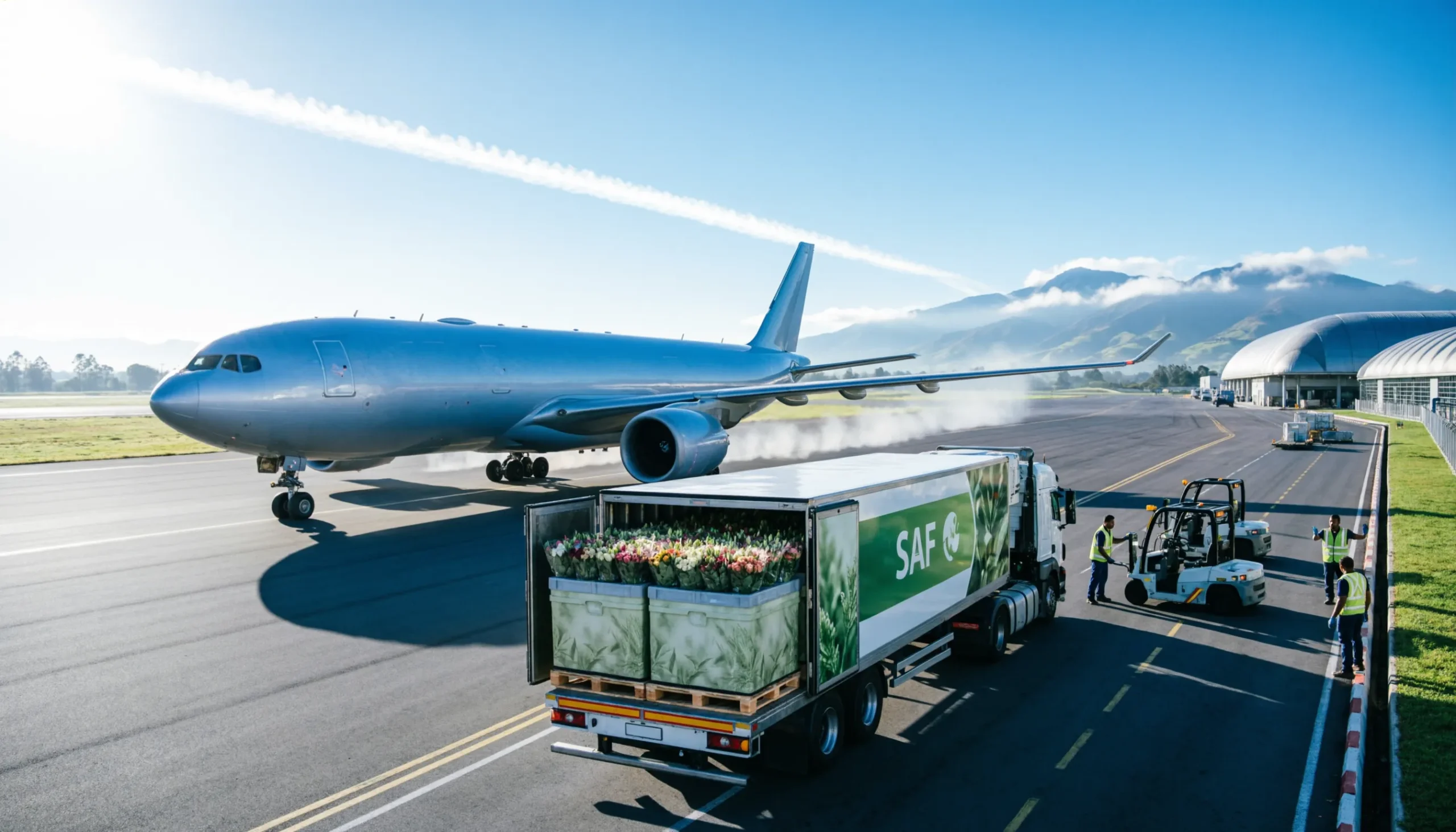
Kuehne+Nagel, LATAM Cargo, and The Elite Flower Execute Latin America’s Largest SAF-Based Flower Export Operation to Cut 300 Tonnes of CO₂e
Recognising the urgent need to reduce emissions in international trade and accelerate the decarbonisation of global logistics, Kuehne+Nagel, LATAM Cargo, and The Elite Flower have successfully completed their largest Sustainable Aviation Fuel (SAF)-based operation in Latin America to date, marking a significant milestone in the region’s push toward greener supply chains. The collaborative initiative resulted in an estimated reduction of approximately 300 tonnes of CO₂e emissions associated with transporting more than 495 tonnes of Colombian flowers—equivalent to around 10 million stems—during one of the floriculture industry’s most critical export windows, the Valentine’s Day season.
The operation focused on exports departing from Bogotá, Colombia, and arriving in Miami, United States, a key trade corridor for the global flower market. By integrating the Book and Claim methodology for SAF, the three partners demonstrated how environmental accountability can be embedded into time-sensitive, high-volume supply chains without compromising operational performance. This achievement underscores a broader industry shift, where sustainability is no longer treated as a secondary objective but rather as an operational imperative closely linked to resilience, competitiveness, and long-term viability.
Decarbonising a Time-Critical Floral Supply Chain
Valentine’s Day represents one of the most intense and logistically demanding periods for flower exporters worldwide. Colombian producers play a central role in meeting global demand, with millions of stems harvested, processed, and shipped within compressed timelines to preserve freshness and quality. The Bogotá–Miami corridor is particularly strategic, serving as a gateway to North American distribution networks and retail channels.
During this peak season, The Elite Flower alone exports nearly 40 million stems via LATAM Cargo, a scale that requires meticulous coordination between growers, freight forwarders, airlines, customs authorities, and distribution partners. In such a context, air freight remains indispensable due to its speed and reliability, ensuring that perishable goods reach their destinations in optimal condition. However, aviation-related emissions have long posed a challenge to the environmental sustainability of this model.
By incorporating SAF into this high-volume operation, the partners were able to substantially lower the carbon intensity of these shipments. The reduction of approximately 300 tonnes of CO₂e demonstrates the tangible environmental impact that can be achieved when industry stakeholders align around measurable sustainability goals. Importantly, the initiative confirms that decarbonisation strategies can be implemented even during peak operational stress periods, proving that environmental performance and commercial performance can coexist.
Leveraging the Book and Claim Model for Scalable Impact
A key element of this initiative was the use of the Book and Claim methodology for Sustainable Aviation Fuel. Under this approach, the environmental attributes of SAF are accounted for and allocated to specific shipments, even if the physical fuel is not directly loaded onto the aircraft carrying those goods. This mechanism enables broader access to SAF benefits in regions where supply may be limited or infrastructure is still developing.
The Book and Claim system is particularly relevant in Latin America, where SAF production and distribution networks are still maturing. By adopting this model, Kuehne+Nagel, LATAM Cargo, and The Elite Flower were able to participate in emissions reduction efforts at scale, despite structural constraints in fuel availability. The approach also provides transparency and traceability, allowing customers to quantify and report the environmental benefits linked to their logistics activities.
For multinational buyers and retailers increasingly focused on Scope 3 emissions reporting, such mechanisms offer a practical pathway to demonstrate progress toward climate commitments. As regulatory frameworks tighten and sustainability disclosures become more rigorous, scalable solutions like Book and Claim are expected to play a pivotal role in bridging the gap between ambition and execution.
Collaborative Leadership in Sustainable Air Logistics
According to Ana San Carlos, Sustainability Manager for Latin America at Kuehne+Nagel, collaboration across the supply chain is fundamental to achieving meaningful progress. She emphasised that working closely with partners generates and drives positive, innovative change in industries such as perishables and air logistics, where reducing carbon emissions is both essential and complex. She highlighted the continued commitment to expand the SAF initiative year after year and to inspire more stakeholders across Latin America and globally to adopt decarbonisation strategies using the Book and Claim methodology.
This perspective reflects a broader transformation within the logistics sector, where sustainability is increasingly integrated into strategic planning and customer engagement. Rather than viewing emissions reduction as an isolated compliance requirement, leading players are positioning it as a driver of innovation and differentiation. The ability to offer lower-carbon transport options enhances value propositions for clients seeking responsible sourcing and distribution models.
Cristina Oñate, Vice President of Sustainability and Product at LATAM Cargo Group, reinforced the importance of collective action in addressing aviation emissions. She noted that managing emissions from the aviation industry requires multiple complementary solutions and, above all, collaboration among airlines, freight forwarders, customers, and fuel suppliers. By applying the environmental benefits of SAF within the flower supply chain, the initiative illustrates how sustainable aviation can evolve through shared responsibility and aligned incentives.
Oñate also underscored that emissions reduction does not detract from the core strengths of air cargo—namely speed and reliability. On the contrary, integrating SAF enhances the sustainability profile of air transport while preserving the operational excellence required for fresh and time-sensitive products such as flowers. This dual benefit strengthens the business case for scaling similar initiatives across other cargo segments.
Operational Excellence Meets Environmental Responsibility
From the exporter’s perspective, the integration of SAF into logistics processes represents both a practical and symbolic advancement. Álvaro Camacho, Logistics Manager at The Elite Flower, explained that managing exports of nearly 40 million stems during the Valentine’s season constitutes a significant operational challenge. Balancing volume, quality assurance, and delivery timelines requires seamless coordination and robust infrastructure.
By incorporating SAF into its transportation strategy, The Elite Flower is actively reducing the carbon footprint of its air freight operations without compromising the freshness, quality, or punctuality of its deliveries. This alignment between operational efficiency and environmental care reflects a broader evolution within the floriculture industry, where sustainability is increasingly recognised as integral to long-term competitiveness.
Consumers in major flower-importing markets are paying closer attention to the environmental and social impact of the products they purchase. Retailers and distributors, in turn, are under pressure to demonstrate responsible sourcing practices. By participating in large-scale SAF initiatives, exporters like The Elite Flower position themselves as proactive contributors to a more sustainable global supply chain.
Advancing Latin America’s Role in Sustainable Trade
The successful execution of this SAF-based operation also signals Latin America’s growing role in sustainable trade innovation. While the region is traditionally associated with agricultural exports and resource-based industries, it is increasingly becoming a testing ground for advanced sustainability models in logistics and aviation.
Colombia, as one of the world’s leading flower exporters, occupies a strategic position in this transition. The ability to decarbonise key export corridors such as Bogotá to Miami has implications that extend beyond the floriculture sector. It sets a precedent for other perishable goods industries—including fruits, vegetables, and seafood—to explore similar pathways.
Furthermore, the partnership between a global logistics provider, a major regional cargo airline, and a leading exporter illustrates how cross-sector collaboration can accelerate systemic change. Each stakeholder brings unique capabilities: Kuehne+Nagel contributes global logistics expertise and sustainability frameworks; LATAM Cargo provides operational capacity and aviation innovation; and The Elite Flower anchors the initiative within the production and export ecosystem. Together, they create a replicable model for sustainable trade.
A Blueprint for Future Decarbonisation Initiatives
The reduction of approximately 300 tonnes of CO₂e linked to transporting 495 tonnes of flowers may represent a single operational milestone, but its broader significance lies in its scalability and replicability. By demonstrating that SAF integration can be achieved at high volumes during peak seasons, the initiative establishes a blueprint for future expansions.
As SAF production increases globally and regulatory incentives strengthen, similar partnerships are likely to expand across additional routes and commodities. The continued refinement of Book and Claim systems will further enhance transparency, enabling companies to align logistics emissions reductions with science-based targets and corporate sustainability reporting standards.
In a global trade environment facing mounting environmental scrutiny, initiatives like this highlight the possibility of aligning economic growth with climate responsibility. By embedding sustainability into the heart of high-speed, high-value supply chains, Kuehne+Nagel, LATAM Cargo, and The Elite Flower have demonstrated that the path toward decarbonised aviation is not theoretical but actionable. Their collaboration sends a clear message: meaningful emissions reductions in air logistics are achievable when innovation, commitment, and partnership converge at scale.
Source Link:https://newsroom.kuehne-nagel.com/