


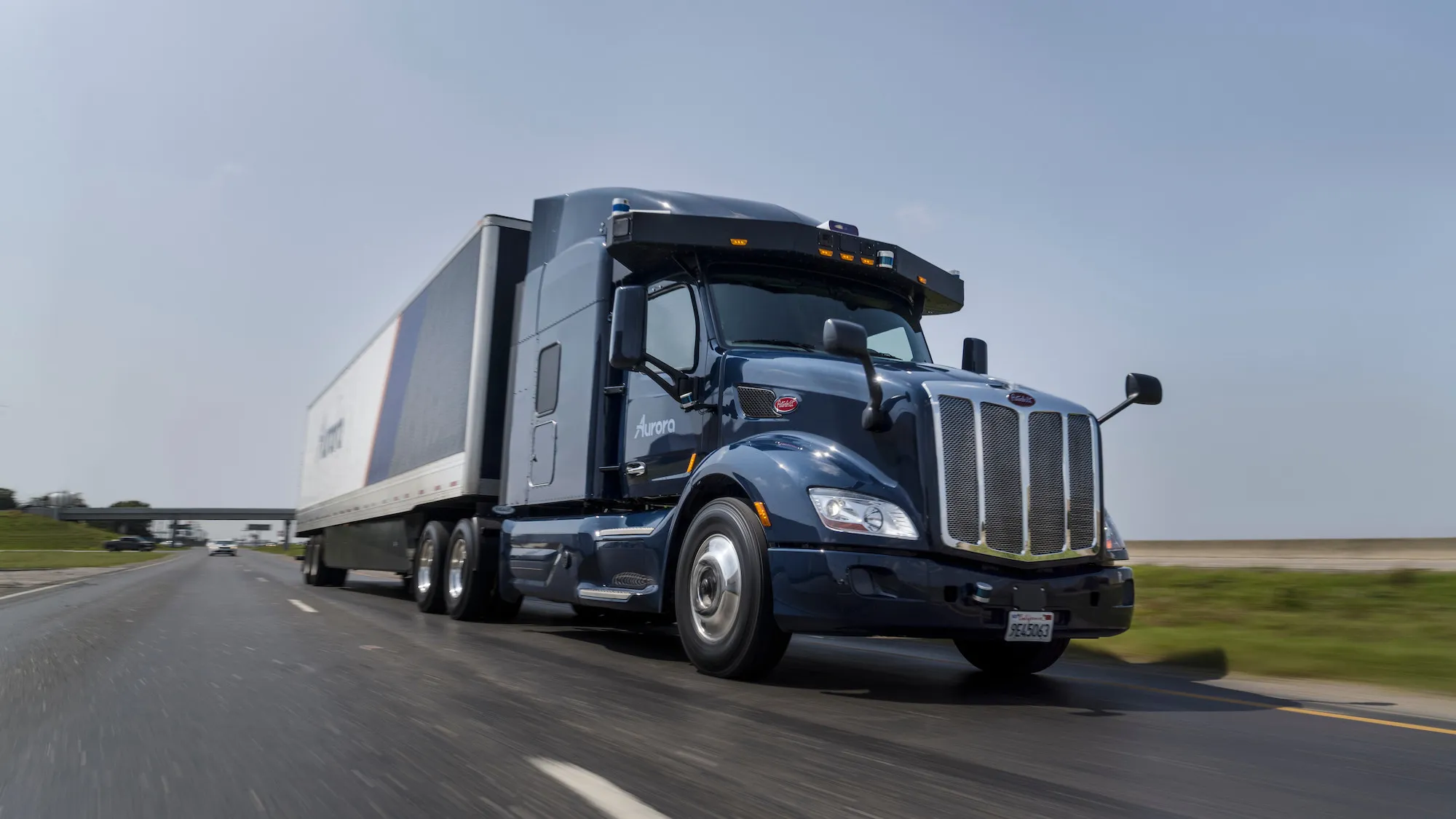
Aurora Innovation, has announced a major expansion of its long-standing partnership with Hirschbach Motor Lines, marking a significant step forward in the commercialization of autonomous trucking in the United States. Under a newly established non-binding memorandum of understanding (MOU), Hirschbach plans to acquire and deploy 500 trucks powered by the Aurora Driver autonomous system. The agreement outlines a long-term collaboration aimed at scaling autonomous freight operations across key national routes, with binding commercial terms expected to be finalized and executed later this year.
The planned expansion represents one of the most ambitious autonomous trucking commitments to date and signals growing industry confidence in self-driving technology as a viable solution for long-haul freight logistics. Once fully implemented, the partnership is expected to enable hundreds of millions of driverless miles while generating a multi-year revenue stream for Aurora valued in the hundreds of millions of dollars.
The agreement reflects a shared vision between Aurora and Hirschbach to transform long-haul trucking through automation while improving efficiency, safety, and driver quality of life. Hirschbach Motor Lines, a leading refrigerated freight carrier in North America, intends to integrate Aurora Driver-powered trucks into its national network beginning in 2027.
Richard Stocking, Chief Executive Officer of Hirschbach Motor Lines, emphasized that the deployment of autonomous trucks is not only a technological advancement but also a strategic enhancement to workforce operations and service quality.
“The Aurora Driver will provide consistent 24/7 service to our customers, making it an important growth lever for our business,” Stocking said. “But autonomy isn’t just a business move – it’s a quality-of-life investment for our people. The Aurora Driver will handle the lengthier, less desirable routes, providing our drivers with greater flexibility. It’s a win-win.”
This hybrid operational model is central to Hirschbach’s long-term strategy. By delegating long-haul freight to autonomous trucks, the company aims to allow human drivers to focus on shorter routes that enable more predictable schedules and improved home time. This approach is expected to enhance driver satisfaction while optimizing overall fleet productivity.
The deployment will operate under Aurora’s Driver-as-a-Service (DaaS) model, a subscription-based framework designed to streamline adoption of autonomous trucking technology. Under this model, customers like Hirschbach maintain ownership and control of the physical truck assets while subscribing to Aurora’s self-driving system.
This structure is intended to deliver significant benefits on both sides of the partnership. Carriers can reduce total cost of ownership (TCO) by improving utilization rates, lowering labor dependency on long-haul routes, and increasing operational efficiency. Meanwhile, Aurora benefits from a scalable, high-margin software-driven revenue model that reduces capital intensity compared to traditional fleet ownership.
Aurora co-founder and Chief Executive Officer Chris Urmson highlighted the accelerating commercial momentum behind the technology, noting that early adopters are beginning to scale their autonomous deployments as performance and reliability continue to improve.
“When early adopters see the benefits the Aurora Driver delivers for their business and their drivers, they don’t just stay the course – they scale quickly,” Urmson said. “We’ve been lucky to have such a thoughtful and innovative partner since our early days and we look forward to growing with them. The industry is primed for this product, and our momentum toward meaningful commercial revenue is hitting a new gear.”
The planned fleet of 500 autonomous trucks will be deployed strategically across Aurora’s expanding commercial network, with a focus on high-density freight corridors in the United States. These include major Sun Belt logistics routes and key interstate lanes that connect manufacturing hubs, distribution centers, and customer facilities.
One of the early operational highlights of the partnership includes Aurora’s recent transition to driverless deliveries to Laredo, Texas, supporting a key Hirschbach customer. This milestone reflects growing operational maturity and demonstrates the system’s readiness for real-world commercial freight movement without a human safety driver.
In addition, Hirschbach is an active customer on Aurora’s 1,000-mile autonomous route between Fort Worth, Texas, and Phoenix, Arizona. This corridor plays a critical role in enabling coast-to-coast freight connectivity and is considered a foundational route for scaling long-haul autonomous operations in the United States.
To date, Aurora reports that its autonomous system has already completed more than 800,000 miles of driving while transporting over 2,000 freight loads for Hirschbach. These operational metrics provide key validation for system reliability and performance in live commercial environments.
Hirschbach’s broader strategy centers on developing a hybrid freight network that integrates autonomous trucks with traditional human-driven operations. In this model, self-driving trucks are expected to take on long-haul, repetitive, and time-intensive routes, while human drivers focus on regional and shorter-haul deliveries that allow for greater schedule flexibility and improved work-life balance.
This dual-system approach is designed to address multiple challenges facing the trucking industry, including driver shortages, rising labor costs, and increasing demand for faster and more reliable freight delivery. By optimizing the division of labor between human and autonomous drivers, Hirschbach aims to increase fleet efficiency while maintaining service quality for its customers.
The company’s experienced “million-mile drivers” have also played a key role in evaluating the performance of Aurora’s autonomous system during its early rollout phase. Their feedback was instrumental in validating system safety, operational reliability, and route performance prior to the launch of driverless operations on Aurora’s inaugural Dallas-to-Houston route.
Stocking reaffirmed the company’s commitment to the hybrid model, emphasizing both operational and workforce benefits.
“We’re proud to deploy a hybrid network with our drivers and autonomous trucks as we move toward a safer, more efficient future for refrigerated freight,” he said.
The expansion to 500 autonomous trucks represents a major milestone in Aurora’s commercialization roadmap and underscores the growing adoption of autonomous driving technology within the freight industry. If successfully executed, the partnership is expected to significantly expand Aurora’s driverless miles, increase revenue visibility, and strengthen its position as a leading provider of autonomous trucking systems.
The agreement also reflects broader industry momentum toward automation as logistics companies seek scalable solutions to persistent operational constraints. As freight demand continues to grow across North America, autonomous trucking is increasingly viewed as a viable pathway to improving efficiency, reducing costs, and enhancing supply chain resilience.
While the current agreement remains in the MOU stage, both companies have indicated strong intent to finalize binding commercial agreements later in 2026, with truck deliveries anticipated to begin in 2027.
The Aurora–Hirschbach partnership represents a defining moment in the evolution of autonomous freight transportation. By combining Aurora’s advanced self-driving technology with Hirschbach’s established logistics network, the collaboration aims to bring autonomous trucking closer to large-scale commercial reality.
As deployment scales over the coming years, the success of this initiative could serve as a benchmark for broader industry adoption, potentially reshaping long-haul freight operations across North America.
Source link: https://www.businesswire.com/