

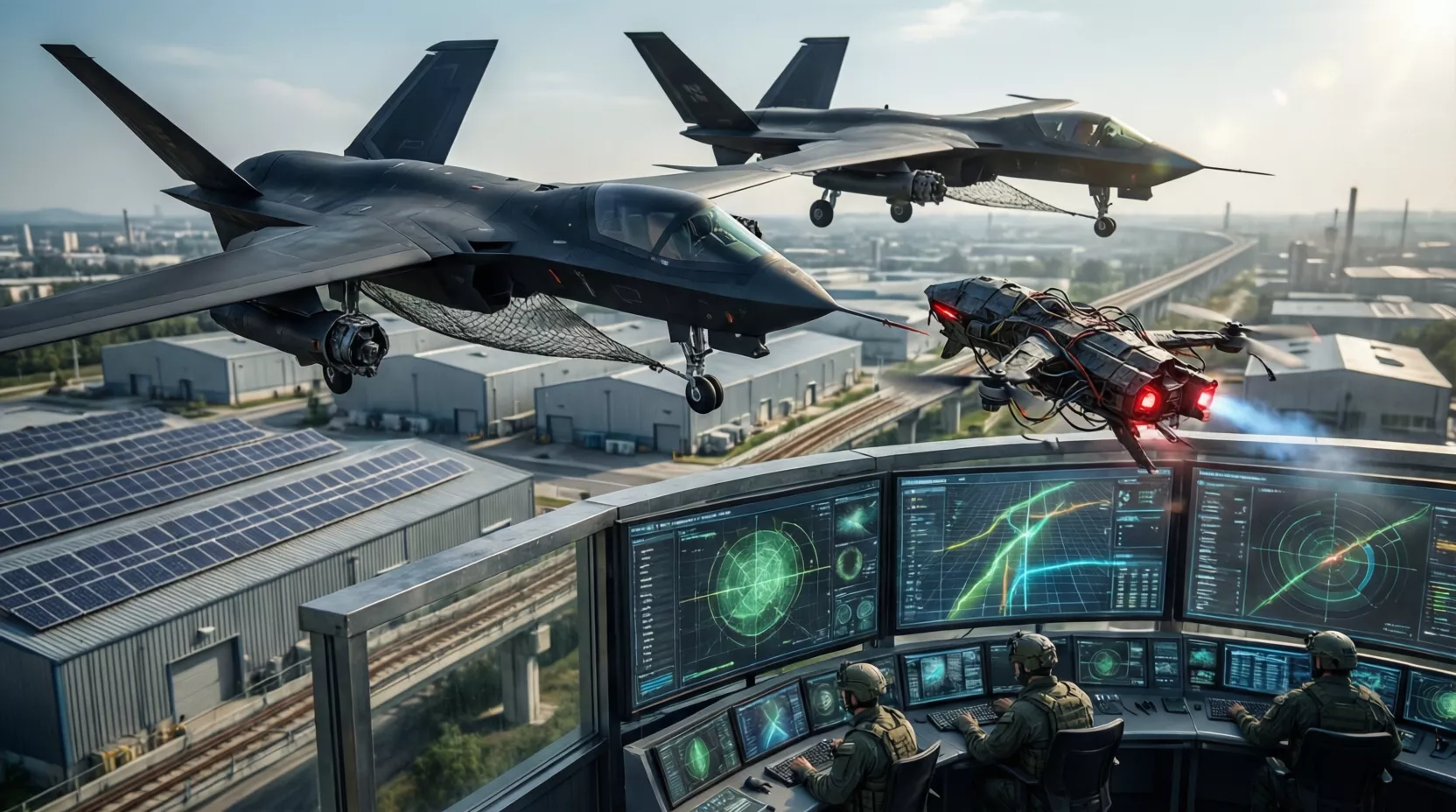
Fortem Technologies Begins Customer Deliveries of DroneHunter® 5.0, Marking a Major Leap Forward in Counter-Swarm Airspace Defense
Fortem Technologies, a global leader in airspace security and counter-drone solutions, has announced the commencement of customer deliveries of its next-generation DroneHunter® 5.0 autonomous interceptor. The new system represents a significant evolution in counter-unmanned aerial system (C-UAS) technology, specifically designed to address the rapidly escalating threat posed by coordinated, multi-drone attacks.
As drone technology becomes more accessible and adversaries increasingly adopt swarm tactics, the need for scalable, autonomous, and low-collateral countermeasures has become a critical priority for military forces, homeland security agencies, and operators of sensitive infrastructure. DroneHunter 5.0 is Fortem’s most advanced interceptor to date, purpose-built to meet this challenge by combining enhanced autonomy, increased speed, improved maneuverability, and multi-target engagement capabilities.
A New Generation Built for a Changing Threat Environment
DroneHunter 5.0 represents a clean departure from earlier iterations of Fortem’s interceptor platform. Rather than incremental upgrades, the fifth-generation system incorporates fundamental architectural changes across sensing, onboard computing, autonomy, and physical design. These enhancements enable a step-change improvement in the system’s ability to detect, track, pursue, and neutralize multiple hostile drones operating simultaneously.
The maturity of the platform was highlighted this month when the Pentagon’s counter-UAS task force selected DroneHunter for its first operational procurement under the Replicator-2 initiative. The selection signals strong confidence in the system’s readiness for scaled, real-world deployment and underscores its relevance to modern defense requirements. Inclusion in Replicator-2 positions DroneHunter 5.0 as a frontline solution for countering evolving drone threats across contested environments.
Advanced Autonomy and Onboard Intelligence
At the core of DroneHunter 5.0 is a substantial leap forward in autonomous decision-making. The system features dual onboard cameras and significantly enhanced onboard computing power, enabling it to independently detect, classify, track, and engage multiple aerial targets without continuous operator input.
This level of autonomy allows DroneHunter 5.0 to operate effectively in complex and contested environments, including areas subject to electronic interference or where rapid response is critical. By reducing reliance on constant human control, the system lowers operator workload and shortens response times, making it particularly valuable in high-tempo scenarios where seconds matter.
Designed and manufactured entirely in-house by Fortem in the United States, DroneHunter 5.0 reflects years of operational testing, end-user feedback, and lessons learned from deployments across a wide range of environments. Each design decision was informed by real-world use cases, ensuring the platform is not only technologically advanced but also operationally practical.
Integration With SkyDome® and Scalable Defense Architecture
DroneHunter 5.0 integrates seamlessly with Fortem’s SkyDome® command-and-control system, a comprehensive airspace awareness and counter-UAS platform that fuses radar, optical sensors, and interceptor coordination into a single operational picture.
With the latest upgrades, SkyDome can now coordinate up to five DroneHunter 5.0 interceptors simultaneously against as many as five concurrent threats. This manned-unmanned teaming architecture allows a single operator or small team to oversee complex engagements involving multiple interceptors, dramatically increasing defensive coverage without proportionally increasing manpower.
This scalability is critical as drone threats evolve from isolated incidents into coordinated swarm attacks. Rather than relying on individually piloted drones, adversaries are increasingly deploying multiple systems designed to operate cooperatively, share targeting data, and overwhelm traditional air defenses. DroneHunter 5.0 and SkyDome together provide a layered, adaptive response capable of countering these tactics.
Lessons From Modern Conflict
The design philosophy behind DroneHunter 5.0 is heavily informed by observations from modern conflicts, particularly the war between Russia and Ukraine. In that theater, drones have become a defining feature of the battlefield, used for reconnaissance, targeting, electronic warfare, and direct attack.
Crucially, adversaries are no longer relying on single, manually controlled drones. Instead, they are fielding coordinated groups capable of synchronized maneuvers, autonomous navigation, and operation under electronic attack. These swarms are designed to exploit gaps in traditional air defenses and impose asymmetric costs on defenders.
Fortem’s next-generation interceptor is explicitly designed to counter this emerging reality. By combining autonomous multi-target engagement with rapid deployment and low-collateral capture methods, DroneHunter 5.0 addresses both the scale and sophistication of modern drone threats.
Low-Collateral Defense for Military and Civilian Use
While DroneHunter 5.0 is optimized for military applications, its design also reflects the growing need for counter-UAS solutions in civilian and dual-use environments. Unlike kinetic interceptors or explosive countermeasures, DroneHunter employs Fortem’s patented entanglement-based capture system to safely neutralize hostile or unauthorized drones.
This approach allows the interceptor to physically capture a target drone, transport it away from sensitive areas, and release it in a controlled manner. The low-collateral nature of this method makes DroneHunter 5.0 suitable for use over populated areas and critical infrastructure where traditional air defense solutions would pose unacceptable risks.
Potential use cases include protection of military bases, airfields, power plants, energy facilities, government buildings, border zones, and major public events. The system’s autonomy further enhances its suitability for civilian security operations by reducing training requirements and enabling rapid deployment by non-specialist teams.
Reduced Operator Burden and Faster Response
A key design goal of DroneHunter 5.0 was to minimize operator burden while maximizing defensive effectiveness. The platform’s autonomous capabilities allow security teams to respond to drone incursions quickly, without the need for continuous manual piloting or complex control inputs.
This reduction in operator workload not only improves response times but also lowers the training barrier for deployment. Organizations can field effective counter-UAS capabilities with smaller teams and shorter training cycles, making advanced airspace defense more accessible across a wider range of users.
According to Fortem, this approach reflects a broader shift in defense technology toward autonomy-enabled systems that augment human decision-making rather than replacing it. Operators remain in control of engagement parameters and rules of engagement, while the system handles the mechanics of pursuit and capture.
Executive Perspective on the Evolving Threat
Commenting on the launch of DroneHunter 5.0 deliveries, Fortem Technologies CEO Jon Gruen emphasized the urgency of staying ahead of a rapidly changing threat landscape.
He noted that drone threats have evolved dramatically in recent years, moving from isolated, low-capability systems to coordinated swarms capable of sophisticated tactics. The enhanced autonomous capabilities of the fifth-generation DroneHunter are designed to counter not just individual drones, but the kinds of swarm attacks increasingly observed in active conflict zones and potentially over civilian airspace in the future.
Gruen highlighted that Fortem’s continued investment in autonomy, sensing, and scalable defense architectures is driven by direct feedback from end users operating in real-world conditions.
Enhanced Physical Design and Field Reliability
Beyond its software and autonomy upgrades, DroneHunter 5.0 also features a redesigned airframe and landing gear intended to improve field reliability and ease of use. These enhancements reduce setup time, simplify deployment, and improve durability in demanding operational environments.
Additional safety features have been incorporated to improve ground handling and operational safety, reflecting Fortem’s emphasis on deployability as well as performance. These refinements are particularly important for forward-deployed units and security teams operating in austere or rapidly changing environments.
The new model also offers an optional four-net-gun configuration, doubling the two-gun standard found on earlier versions. This increased capture capacity provides greater flexibility when engaging multiple targets in quick succession, further enhancing the system’s effectiveness against swarm threats.
Positioning for Scaled Deployment
With deliveries now underway and validation from the U.S. Department of Defense through the Replicator-2 initiative, DroneHunter 5.0 is positioned for broader adoption across military, homeland security, and critical infrastructure protection markets.
As drone threats continue to proliferate globally, demand for effective, scalable, and low-collateral counter-UAS solutions is expected to grow. Fortem’s integrated approach—combining radar detection, autonomous interception, and centralized command and control—offers a comprehensive answer to this challenge.
Defining the Future of Counter-UAS Defense
DroneHunter 5.0 represents more than a new product release; it signals a shift in how airspace defense is conceived and executed. By embracing autonomy, scalability, and safe capture methods, Fortem Technologies is redefining what effective counter-drone defense looks like in an era of rapidly evolving threats.
As adversaries continue to innovate, the ability to counter coordinated drone attacks will be a defining factor in both military and civilian security. With the start of customer deliveries, DroneHunter 5.0 moves from development into operational reality, offering a glimpse of the future of counter-swarm defense and reinforcing Fortem’s position at the forefront of airspace security technology.
Source link: https://www.businesswire.com