


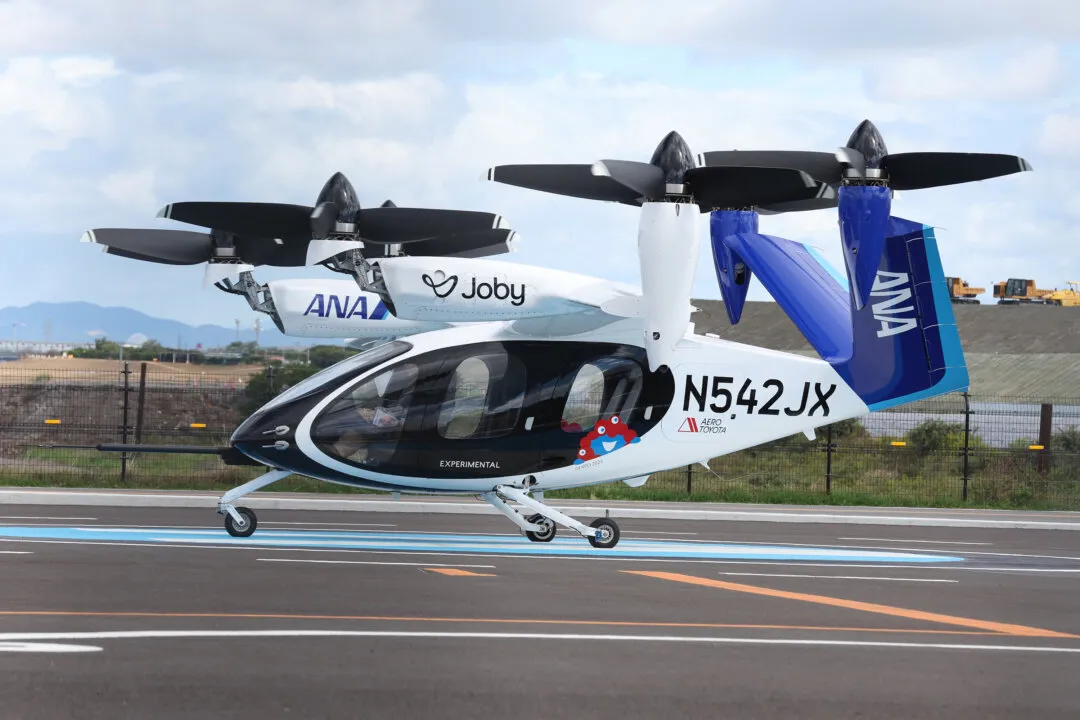
Joby Aviation, Inc., a leading developer of electric air taxis for commercial passenger transportation, has completed the first-ever point-to-point electric vertical takeoff and landing (eVTOL) air taxi demonstration flights in New York City. The milestone event marks the beginning of a week-long public campaign designed to showcase how next-generation air mobility could transform travel across one of the busiest metropolitan regions in the world.
The campaign features flights across New York City’s established heliport network and demonstrates how electric air taxis can provide fast, quiet, and zero operating-emission transportation between Manhattan, airports, and surrounding communities. Against the backdrop of the city’s iconic skyline, Joby’s aircraft is offering residents, policymakers, and industry stakeholders a glimpse into the future of urban transportation.
The demonstration campaign centers on Joby’s aircraft, registration N545JX, which operated flights departing from John F. Kennedy International Airport (JFK) and landing at several heliports across the city.
These locations included:
These heliports already serve helicopter operations and premium urban air travel services, making them natural candidates for future electric air taxi operations. Together, the sites outline routes that Joby expects could become commercially viable in the future, including direct connections between Midtown Manhattan, Lower Manhattan, and JFK Airport.
According to the company, trips between Manhattan and JFK could take under 10 minutes using Joby’s aircraft—dramatically reducing travel times compared with road journeys that often exceed one hour.
JoeBen Bevirt, founder and CEO of Joby Aviation, said New York has always embraced innovation and high standards, making it the ideal setting to showcase the next chapter of transportation.
He noted that Joby first flew in New York in 2023, but the latest campaign demonstrates what a real commercial service could look like. By operating flights between JFK and Manhattan, Joby aims to show the practical benefits of electric air taxi services and the progress made under the White House-backed eVTOL Integration Pilot Program (eIPP).
Bevirt emphasized that Joby’s aircraft is specifically designed to be quiet, efficient, and environmentally responsible while helping residents reclaim valuable time lost in traffic congestion.
The Port Authority of New York and New Jersey, which oversees major regional transportation infrastructure including airports, bridges, tunnels, and seaports, played a key role in facilitating the demonstration flights.
Port Authority Chairman Kevin O’Toole described the aircraft as the type of innovation that transportation agencies must evaluate and understand to prepare for future mobility needs.
He said the agency is responsible for ensuring its infrastructure network evolves with changing demands and technologies. Demonstration flights such as these help determine how advanced aviation can serve the public interest in the years ahead.
Port Authority Executive Director Kathryn Garcia added that the region’s airports are among the busiest in the world, making it essential to think long-term about sustainability, efficiency, and passenger needs.
She noted that testing new technologies today allows transportation leaders to make informed decisions for the future.
The initiative is also backed by the New York City Economic Development Corporation (NYCEDC), which is leading efforts to modernize the city’s heliport infrastructure in preparation for commercial air taxi services.
Working in partnership with Skyports Infrastructure and Vertiports by Atlantic, NYCEDC is helping electrify heliports so they can support charging systems and operational requirements for eVTOL aircraft.
Jeanny Pak, Interim President and CEO of NYCEDC, described the flights as proof that advanced air mobility is no longer a futuristic concept but an emerging reality.
She said the city is committed to creating a greener and more innovative transportation network while building on recent upgrades to heliports that also support maritime logistics and sustainable delivery systems.
A major part of Joby’s New York strategy is its acquisition of Blade Air Mobility’s passenger business in 2025. The transaction gave Joby direct access to an established customer base, operational expertise, and premium passenger facilities in Manhattan and at key airports.
Blade served more than 90,000 passengers in 2025, highlighting strong demand for premium short-distance air travel in the region.
By integrating Blade’s infrastructure and customer relationships, Joby aims to accelerate the transition away from traditional helicopters toward electric aircraft that are quieter and emission-free.
This acquisition also gives Joby a significant commercial advantage by allowing it to scale service more rapidly once regulatory approvals are secured.
Traffic congestion remains one of New York City’s most persistent challenges. One estimate found that a typical commuter lost 102 hours to traffic delays in 2025.
Joby sees this problem as one of the strongest use cases for electric air taxis.
Its vision is to convert a 60-to-120-minute road trip between Manhattan and JFK Airport into a seven-minute flight. This could save travelers substantial time while reducing pressure on already crowded roads and rail links.
The company also plans to integrate its services with existing transportation networks through partnerships with Delta Air Lines and Uber.
This would allow customers to book end-to-end journeys that combine rideshare vehicles, airport connections, and air taxi flights in a seamless travel experience.
Urban air mobility depends heavily on public acceptance, and Joby has focused strongly on safety and community compatibility.
The aircraft includes multiple redundancies across key systems to improve reliability and operational resilience. This design philosophy is intended to meet rigorous aviation certification standards and support safe passenger operations.
Noise reduction is another critical advantage.
Traditional helicopters are often criticized for loud rotor noise, particularly in dense urban neighborhoods. Joby says its aircraft produces a significantly lower noise footprint than similarly sized helicopters and blends more naturally into ambient city soundscapes.
This quieter profile could make eVTOL aircraft more acceptable for regular use in populated areas.
The New York campaign also celebrates the city’s selection in March under the federal eVTOL Integration Pilot Program (eIPP), established by executive order to accelerate deployment of next-generation air transportation systems across the United States.
Joby was selected as a partner in five projects across 12 states, highlighting the company’s national leadership position in the sector.
The Port Authority led one of the selected projects and worked closely with the Federal Aviation Administration (FAA), Joby, and other stakeholders to enable these flights.
The program is intended to test real-world operations, regulatory frameworks, infrastructure planning, and public engagement needed for commercial launch.
Joby is also making progress toward final FAA certification, a crucial step before launching commercial passenger services.
Recently, the company flew its first conforming aircraft for Type Inspection Authorization (TIA), which enables FAA pilots to conduct official for-credit flight testing.
This milestone moves Joby closer to certification and eventual market entry.
The New York campaign serves as a practical demonstration of how the aircraft performs in complex real-world environments, including busy airspace, dense urban infrastructure, and demanding route networks.
The New York flights are the latest stop in Joby’s 2026 Electric Skies Tour, a national campaign timed to celebrate the 250th anniversary of the United States.
The tour began in the San Francisco Bay Area, where Joby completed a landmark flight over the Golden Gate Bridge.
By bringing the aircraft to major cities across the country, Joby is raising public awareness while demonstrating that electric aviation is ready to move beyond prototypes into practical transportation systems.
Joby’s week-long New York City campaign represents more than a technology showcase—it signals a shift in how cities may approach mobility in the coming decades.
If successful, electric air taxis could:
For New York City, where time is one of the most valuable commodities, the ability to move between Manhattan and JFK in minutes could redefine premium urban transportation.
Joby Aviation’s historic electric air taxi flights in New York City mark a major milestone for both the company and the broader advanced air mobility industry. By demonstrating real point-to-point operations across existing heliport infrastructure, Joby has shown that electric urban flight is no longer theoretical.
With strong support from city agencies, the Port Authority, federal programs, and strategic partners, New York may become one of the first global cities to adopt commercial electric air taxi services at scale.
As certification progresses and infrastructure develops, Joby’s vision of seven-minute airport transfers and cleaner skies may soon become part of everyday life in the city that never sleeps.
Source link: https://www.businesswire.com/