

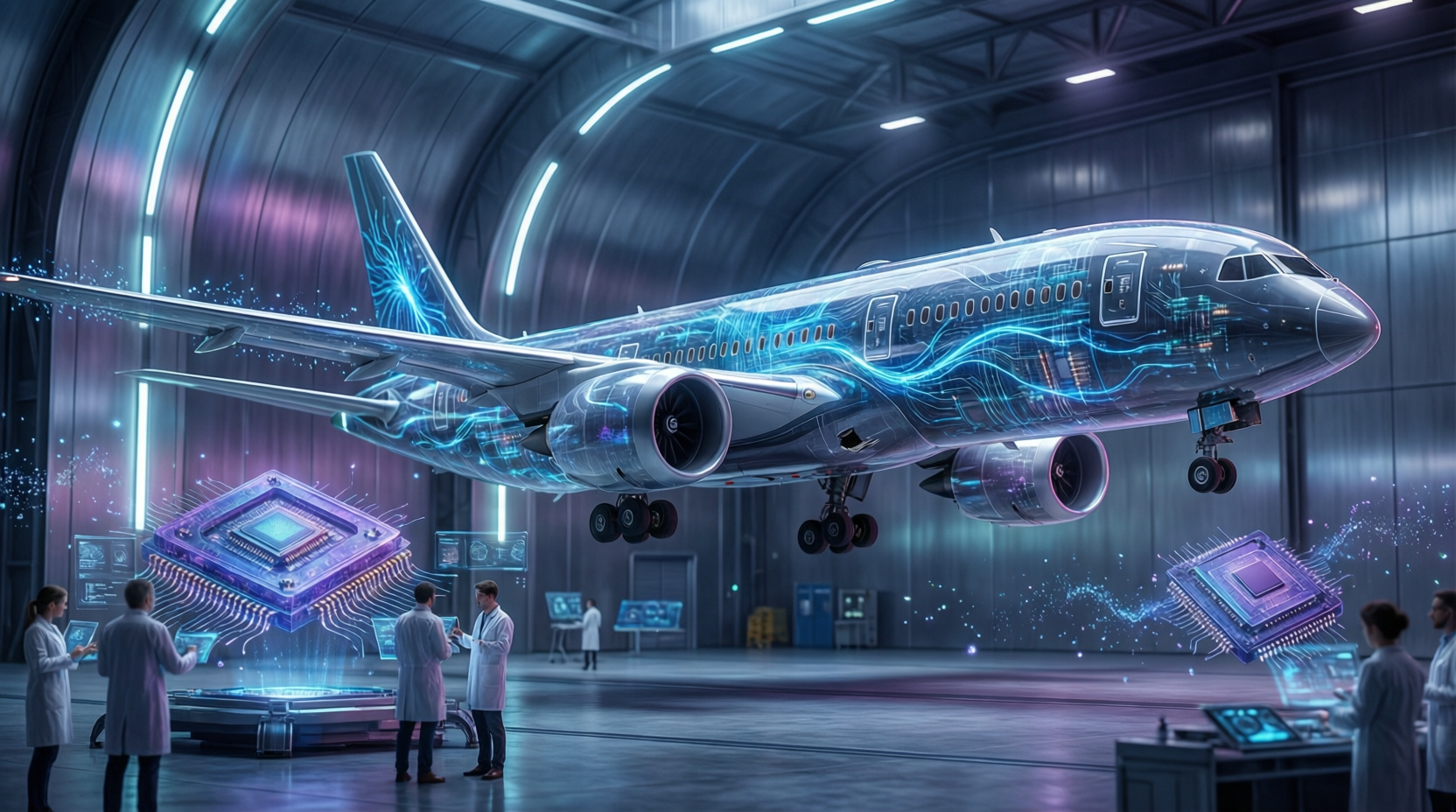
PsiQuantum Partners with Airbus to Advance Fault-Tolerant Quantum Computing for Aerospace Applications
PsiQuantum, a leading developer of fault-tolerant quantum computers, announced today a strategic collaboration with Airbus, Europe’s largest aerospace and space company, to advance applications of quantum computing in the aerospace sector. Under the QuLAB project, the two companies are combining their respective expertise to develop and evaluate quantum algorithms for complex fluid mechanics problems, showcasing the transformative potential of fault-tolerant quantum computing in solving some of the aerospace industry’s most challenging computational problems.
This partnership highlights the growing interest in applying quantum computing to critical scientific and engineering domains, including computational fluid dynamics (CFD), materials science, and aerodynamic modeling. By leveraging the capabilities of fault-tolerant quantum computers, PsiQuantum and Airbus aim to address computational challenges that are difficult or impossible to solve efficiently using classical supercomputers.
Quantum Computing Meets Aerospace
Quantum computing has the potential to revolutionize industries that rely on complex simulations, optimization, and modeling. For aerospace, these capabilities are particularly compelling. Designing aircraft, spacecraft, and related systems often requires simulating nonlinear fluid flows, aerodynamic drag, vibration responses, and material interactions. Traditional high-performance computing systems, while powerful, are often stretched thin when tackling large-scale simulations at the level of precision and speed that modern aerospace demands.
The collaboration between PsiQuantum and Airbus focuses on applying fault-tolerant quantum computing to these problems. Unlike current quantum devices, which are limited by errors and decoherence, fault-tolerant quantum computers can perform high-precision, error-corrected calculations, opening the door to simulations of unprecedented complexity and accuracy.
Alexander Kolks, Chief Business Officer at PsiQuantum, emphasized the significance of the partnership:
As PsiQuantum prepares to build and deploy the world’s first fault-tolerant quantum computers, we are working closely with world-leading companies to ensure they are prepared to take full advantage of this technology. Our partnership with Airbus underscores quantum computing’s game-changing potential for the aerospace industry—and our shared commitment to collaborate at the leading edge.”
Groundbreaking Research on Quantum Fluid Dynamics
Central to the collaboration are two recent publications that illustrate the practical applications of fault-tolerant quantum computing in aerospace.
The first, “Simulating Non-Trivial Incompressible Flows With a Quantum Lattice Boltzmann Algorithm,” presents a novel approach to solving incompressible fluid flow problems under realistic aerospace conditions. Incompressible flows, which are common in aerodynamic analysis, are notoriously difficult to simulate efficiently due to the complex interactions and constraints in fluid behavior. By leveraging quantum algorithms, researchers can achieve precise calculations of fluid dynamics that would otherwise be computationally prohibitive.
The second paper, “An End-To-End Quantum Algorithm for Nonlinear Fluid Dynamics With Bounded Quantum Advantage,” builds upon the theoretical foundations developed by PsiQuantum and Airbus researchers. This work outlines methods for preparing, executing, and validating complex quantum simulations on a fault-tolerant quantum computer, demonstrating that such systems can be optimized for real-world aerospace applications. Together, these papers provide a roadmap for integrating quantum computing into CFD, particularly for benchmarking problems related to aircraft aerodynamics.
PsiQuantum shared additional insights about these studies in a recent blog post, and the research team is scheduled to present their findings at the American Institute of Aeronautics and Astronautics (AIAA) SciTech 2026 Forum in Orlando, Florida, this week, highlighting the growing interest and collaboration between quantum computing and aerospace research communities.
The Promise of Fault-Tolerant Quantum Computing
Fault-tolerant quantum computers are uniquely suited to simulate systems governed by quantum chemistry, partial differential equations (PDEs), and other complex mathematical models, which are foundational in aerospace engineering. These simulations are critical for tasks such as:
- Predicting aerodynamic drag and lift characteristics
- Modeling vibrations and structural stress under various conditions
- Analyzing material interactions at a molecular level
- Optimizing fuel efficiency and environmental performance
Current classical supercomputing resources are often insufficient to run these simulations at the scale, speed, and accuracy required for next-generation aerospace applications. Fault-tolerant quantum computers promise to drastically improve computational throughput, enabling faster, more accurate predictions and designs. This advancement could accelerate aircraft development, reduce testing costs, and enhance operational efficiency.
Kolks highlighted the potential impact:
“Quantum computing offers the aerospace industry the ability to model, simulate, and optimize designs at scales that were previously out of reach. This is not just a technological advance—it has the potential to fundamentally transform how we design and operate aircraft.”
Preparing for the Era of Utility-Scale Quantum Computing
While the promise of quantum computing is immense, realizing its full potential requires specialized algorithms tailored to fault-tolerant systems. To address this need, PsiQuantum launched Construct, a software suite for designing, developing, and optimizing fault-tolerant quantum algorithms, in September 2025. Construct enables companies to explore and implement quantum solutions that are scalable and efficient, preparing them to capitalize on the first generation of utility-scale quantum computers.
The collaboration with Airbus demonstrates how industry leaders can co-develop algorithms and workflows that maximize the benefits of quantum computing. By focusing on aerospace-specific applications, such as CFD and aerodynamic modeling, PsiQuantum and Airbus are laying the groundwork for a new class of simulation tools that could revolutionize design and engineering processes.
As Airbus integrates these quantum algorithms into its research pipeline, engineers will be able to perform high-fidelity simulations more quickly, enabling better-informed decisions in aircraft design, testing, and production. This synergy between quantum computing innovation and aerospace expertise illustrates the transformative potential of cross-industry collaboration.
Why Aerospace is Poised for Quantum Transformation
The aerospace sector is particularly well-positioned to benefit from quantum computing due to the complex, multi-scale nature of the problems it addresses. From airflow over wings to heat transfer in engines, each calculation involves intricate interactions that are difficult to approximate using classical methods. Fault-tolerant quantum computing can handle these complexities, allowing for:
- Faster design cycles for aircraft and spacecraft
- Improved fuel efficiency and reduced environmental impact
- Enhanced safety through more accurate modeling of extreme conditions
- Optimized materials and structures for weight reduction without sacrificing strength
By combining Airbus’ deep knowledge of aerospace engineering with PsiQuantum’s quantum expertise, the collaboration seeks to unlock new possibilities in aircraft performance, environmental sustainability, and design innovation.
As PsiQuantum progresses toward building the world’s first fault-tolerant quantum computers, partnerships with industry leaders like Airbus ensure that these groundbreaking technologies are applied where they can have immediate, transformative impact. The collaboration reflects a broader trend of quantum computing adoption in industrial research, where companies are preparing now for the arrival of utility-scale quantum systems.
By developing and validating quantum algorithms for complex fluid dynamics and other aerospace applications, PsiQuantum and Airbus are helping define the first practical use cases for fault-tolerant quantum computing. These efforts will not only enhance simulation capabilities but also establish best practices and frameworks for future quantum applications across industries.
As the field evolves, the insights gained from the PsiQuantum-Airbus collaboration will likely inform other sectors, including automotive, energy, and materials science, where high-fidelity simulations are critical. The partnership exemplifies how quantum computing can transition from theoretical research to real-world industrial impact, bridging the gap between cutting-edge technology and practical application.
PsiQuantum is a pioneering company in the field of fault-tolerant quantum computing. The company is focused on building the first commercially viable, large-scale quantum computers capable of solving problems that are intractable for classical systems. PsiQuantum combines photonic quantum technology with advanced error-correction techniques to enable precise, scalable quantum computation for a wide range of scientific and industrial applications.
Airbus is Europe’s largest aerospace and space company, a global leader in commercial aircraft, defense, and space systems. Known for its innovation in aircraft design, manufacturing, and technology integration, Airbus continually invests in research and development to push the boundaries of aerospace engineering and sustainability.
By collaborating under the QuLAB project, PsiQuantum and Airbus are taking the first concrete steps toward realizing the potential of fault-tolerant quantum computing in aerospace. From simulating complex fluid dynamics to optimizing aircraft design and performance, the partnership represents a milestone in both quantum technology and aerospace innovation, signaling a future where quantum-enabled solutions redefine what is possible in the skies and beyond.
Source link: https://www.businesswire.com