


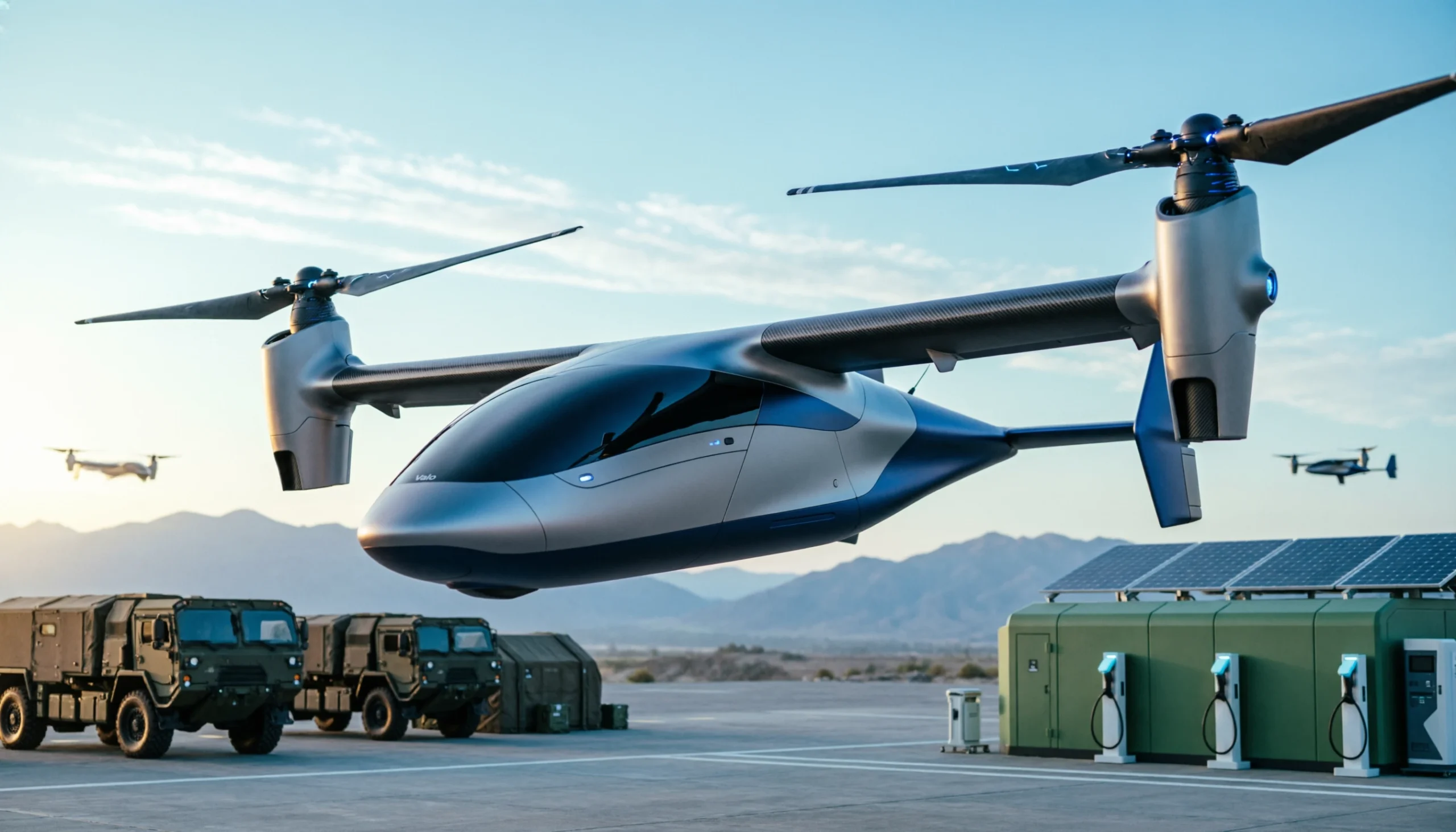
Vertical Aerospace (NYSE: EVTL), a global aerospace and technology company focused on electric aviation, has signed a Memorandum of Understanding (MoU) with Near Earth Autonomy, a leading developer of autonomous flight systems, to establish a strategic partnership aimed at bringing advanced autonomous capabilities to the Valo aircraft platform.
The collaboration is designed to expand Valo’s capabilities for both defense and commercial operations by integrating Near Earth’s autonomous flight technology with Honeywell Aerospace’s Anthem, the next-generation digital cockpit already selected for the aircraft. Since both technologies have been developed with compatibility in mind, the companies expect the integration to provide a faster, lower-risk pathway for introducing autonomous flight capabilities into future aircraft.
Founded in 2012, Near Earth Autonomy has built extensive expertise in autonomous aviation through projects with the U.S. Marine Corps, U.S. Army, and Honeywell Aerospace. Its experience includes work on optionally piloted Black Hawk helicopters and autonomous flight demonstrations using the Leonardo AW139 platform.
Under the partnership, Vertical Aerospace and Near Earth plan to pursue immediate defense opportunities while establishing a long-term roadmap for increasingly automated commercial aviation operations.
Valo has been designed as a flexible aircraft platform capable of supporting multiple mission profiles. Alongside its all-electric tiltrotor configuration, Vertical is developing a hybrid-electric variant capable of flying up to 1,000 miles, carrying payloads of up to 1,100 kg over shorter distances, while maintaining low acoustic and thermal signatures suitable for defense and special mission operations. These capabilities position Valo for missions including logistics, resupply, distributed operations, and other government and commercial applications.
By utilizing a common aircraft platform across commercial and defense markets, Vertical aims to accelerate development, reduce operational costs, and deliver new capabilities to customers more efficiently.
Stuart Simpson, CEO of Vertical Aerospace, said the partnership represents an important step in strengthening the company’s position in the defense sector while supporting its broader strategy of creating a scalable aerospace business.
He noted that Valo was designed from the beginning as a versatile platform, combining hybrid-electric propulsion, advanced autonomy, and proprietary battery technology to meet the needs of commercial operators, governments, and defense organizations. Simpson also highlighted Near Earth’s extensive experience in autonomous aviation, stating that the collaboration will help create a next-generation aircraft platform capable of supporting future commercial and defense missions.
Dr. Sanjiv Singh, CEO and Co-Founder of Near Earth Autonomy, said the company has spent more than a decade developing autonomous flight systems for demanding aviation missions. He added that integrating Near Earth’s autonomy technology with Vertical’s next-generation aircraft and Honeywell Aerospace’s open digital cockpit creates an opportunity to accelerate the deployment of autonomous capabilities across both commercial and defense sectors.
Bob Buddecke, President and CEO of Electronic Solutions at Honeywell Aerospace, said Anthem was built as a modular and expandable digital cockpit architecture capable of supporting future aviation technologies. He noted that the partnership demonstrates how advanced autonomy and aircraft systems can be integrated on Anthem’s digital backbone, enabling scalable open-architecture solutions for commercial and defense aviation.
The announcement comes ahead of the Farnborough International Airshow, taking place from 20–24 July 2026, and reflects Vertical Aerospace’s strategy of building a strong technology ecosystem. In addition to Near Earth, the company collaborates with major aerospace technology partners including Honeywell Aerospace, Aciturri, Evolito, Hyundai WIA, Astronics, Syensqo, and Isoclima to develop the technologies that support the Valo aircraft platform and its common architecture.
About Vertical Aerospace
Vertical Aerospace is a global aerospace and technology company pioneering electric aviation. Vertical is creating a safer, cleaner, and quieter way to travel. Valo is a piloted, four-passenger, Electric Vertical Take-Off and Landing (eVTOL) aircraft, with zero operating emissions. Vertical is also developing a hybrid-electric variant, offering increased range and mission flexibility to meet the evolving needs of the advanced air mobility market.
Vertical combines partnerships with leading aerospace companies, including Honeywell Aerospace, Syensqo and Aciturri, with its own proprietary battery and propeller technology to develop the world’s most advanced and safest eVTOL.
Vertical has c.1,500 pre-orders of Valo, with customers across four continents, including American Airlines, Avolon, Bristow, GOL and Japan Airlines. Certain customer obligations are expected to be fulfilled via third-party agreements. Headquartered in Bristol, UK, Vertical’s experienced leadership team comes from top-tier aerospace and automotive companies such as Rolls-Royce, Airbus, GM, and Leonardo. Together, they have previously certified and supported over 30 different civil and military aircraft and propulsion systems.
About Near Earth Autonomy
Near Earth’s technology allows aircraft to autonomously take off, fly, and land safely, with or without GPS. Its solutions enable aerial mobility applications for partners in the commercial and defense sectors. Near Earth bridges the gap between aerospace and robotics with complete systems that improve efficiency, performance, and safety for aircraft ranging from small drones to large helicopters.