

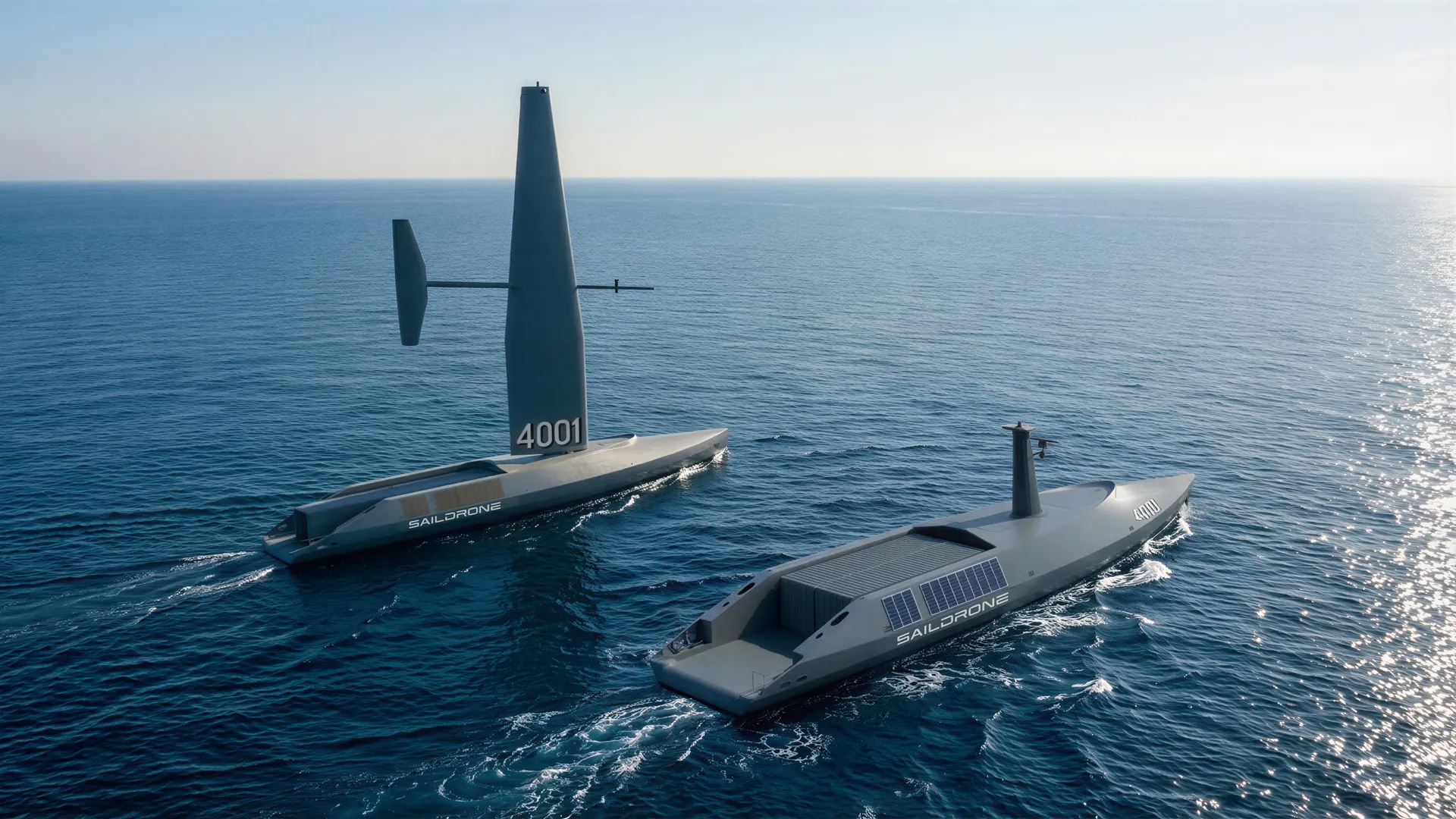
Fincantieri to Build Spectre, a Next-Generation High-Speed Unmanned Surface Vessel for Future Naval Operations
Fincantieri, one of the world’s leading shipbuilding groups, has announced that it will construct Spectre, a new class of advanced high-speed unmanned surface vessel (USV), through its U.S. subsidiary Fincantieri Marine Group (FMG). The vessel has been developed in partnership with Saildrone, a global pioneer in autonomous maritime systems and one of the most experienced operators of unmanned surface vehicles worldwide.
The launch of the Spectre program marks an important milestone in the modernization of naval capabilities and demonstrates how traditional shipbuilding expertise is increasingly converging with cutting-edge autonomous technologies. Designed as a multi-mission vessel capable of supporting a range of naval tasks, Spectre reflects the growing demand among modern armed forces for scalable, reliable, and autonomous maritime platforms.
The collaboration was officially unveiled during the Navy League’s Sea-Air-Space exhibition at National Harbor, Maryland, one of the premier events for maritime defense innovation. The announcement highlights the strategic importance of unmanned systems in the future structure of naval fleets and underscores Fincantieri’s ambition to expand its role beyond conventional shipbuilding into integrated defense technologies.
Responding to Rapidly Changing Naval Requirements
Modern navies around the world are facing a rapidly changing strategic environment. Maritime security threats are evolving, operational areas are expanding, and fleet commanders are being asked to do more with limited personnel and tighter budgets. In this environment, unmanned systems have become increasingly attractive because they can extend operational reach, lower risk to crews, and remain deployed for long durations.
Spectre has been specifically conceived to address these emerging challenges. It offers naval forces a platform that combines speed, endurance, modularity, and autonomous capability. Unlike many earlier unmanned vessels designed for narrow tasks such as surveillance or environmental monitoring, Spectre has been built as a multi-role system capable of supporting demanding military operations.
The vessel is expected to provide armed forces with a solution that can be deployed in larger numbers, enabling distributed maritime operations. This concept is becoming central to many naval strategies, where numerous smaller and autonomous platforms work together to complement larger crewed warships.
Combining Saildrone Innovation with Fincantieri Industrial Strength
The partnership brings together two organizations with highly complementary strengths.
Saildrone has established itself as a leader in autonomous maritime technology. Its fleet of unmanned vessels has operated across oceans for scientific research, maritime domain awareness, border security, and defense missions. The company has built a reputation for endurance, data collection, and operational reliability in harsh marine environments.
Fincantieri, meanwhile, is one of the largest shipbuilders in the world, with extensive experience designing and constructing naval ships, cruise vessels, offshore platforms, and specialized marine craft. Through its U.S.-based operations, the company has become a major supplier to the American maritime sector.
By joining forces, the two companies aim to bridge the gap between innovative prototype technology and industrial-scale production. This is increasingly important in defense markets, where governments seek not only advanced technology but also dependable manufacturing capacity and rapid delivery schedules.
Fincantieri’s industrial capabilities, supply chain expertise, and established production systems provide the foundation to turn Spectre from an advanced concept into a fleet-ready operational asset.
Construction in Wisconsin Shipyards
Production of Spectre will take place at Fincantieri’s network of shipyards in Wisconsin, leveraging existing facilities and a highly skilled American workforce.
This location is strategically significant. Wisconsin has long been associated with advanced shipbuilding and marine manufacturing, and Fincantieri’s operations in the state have delivered numerous vessels for defense and commercial customers. Using these facilities allows the company to move quickly into production while maintaining high quality standards.
The program also supports domestic industrial priorities in the United States by creating work for local suppliers, engineers, technicians, and shipyard employees. As defense procurement increasingly emphasizes resilient supply chains and local production capacity, this element of the Spectre project carries strong strategic value.
By utilizing proven infrastructure rather than building new facilities from scratch, Fincantieri can accelerate timelines and reduce execution risk.
A Powerful New Autonomous Vessel
Spectre stands out not only because of its autonomy, but because of its size and performance.
At approximately 52 meters in length, with a displacement of around 250 tons, the vessel is significantly larger than many existing unmanned surface systems. It is also expected to reach top speeds of up to 30 knots, giving it the pace needed for demanding naval operations.
According to the companies involved, Spectre is the largest, fastest, and most capable Saildrone platform developed to date. This represents a major evolution in the unmanned maritime sector, where many systems have traditionally focused on small or medium-sized vessels.
Its increased size enables greater payload capacity, longer endurance, and the integration of more sophisticated mission equipment. That makes Spectre suitable not only for patrol duties, but also for high-value operational roles that require persistence and advanced sensors.
Optimized for Anti-Submarine Warfare
One of Spectre’s most notable design priorities is its optimization for anti-submarine warfare (ASW).
Submarine threats remain a major concern for naval forces around the world. Detecting and tracking submarines is resource-intensive, often requiring expensive crewed ships, aircraft, and sonar networks. Autonomous vessels such as Spectre can help expand surveillance coverage at lower operating cost.
The platform is designed to deliver extreme endurance and an ultra-quiet acoustic signature, both critical characteristics for ASW missions. Low acoustic noise helps reduce interference with sonar systems and minimizes the vessel’s detectability in sensitive environments.
An autonomous ASW platform capable of remaining at sea for extended periods could transform how navies monitor chokepoints, coastal approaches, and strategic sea lanes.
Flexible Multi-Mission Capability
Although optimized for submarine-hunting missions, Spectre has been designed as a modular vessel that can be adapted for a wide range of alternative tasks.
Potential mission profiles could include:
- Maritime surveillance and reconnaissance
- Intelligence gathering
- Force protection for naval task groups
- Mine countermeasure support
- Electronic warfare payload integration
- Logistics or communications relay roles
- Border security and patrol missions
The vessel can also be configured for higher-speed missions and low-observable operational profiles, enhancing flexibility for future use cases.
This modularity is increasingly valuable because threat environments change rapidly. Rather than building separate vessels for every role, navies are seeking adaptable platforms that can evolve over time through payload changes and software upgrades.
Fincantieri’s Strategic Transformation
The Spectre announcement also signals a broader shift in Fincantieri’s corporate strategy.
Traditionally recognized as a shipbuilder, the company is increasingly positioning itself as a provider of integrated maritime defense systems. That means combining hull construction expertise with digital technologies, mission systems, autonomy, and lifecycle support services.
Pierroberto Folgiero, Chief Executive Officer and Managing Director of Fincantieri, emphasized this transition when commenting on the project. He described Spectre as another step in transforming Fincantieri from a conventional shipbuilder into a system-level industrial integrator for future naval forces.
This evolution mirrors broader trends across the defense industry, where shipyards and manufacturers are moving into software-enabled and systems-based solutions rather than focusing only on hardware.
Supporting the United States and Allied Navies
The program also reinforces Fincantieri’s long-term commitment to the United States defense sector.
By producing Spectre through its American subsidiary and U.S.-based shipyards, the company aligns itself with domestic procurement priorities while supporting operational readiness for the U.S. Navy and allied maritime forces.
Allied navies increasingly require interoperable systems that can work together in coalition operations. Autonomous platforms such as Spectre could be especially valuable in multinational maritime missions involving surveillance, patrol, deterrence, and contested-zone operations.
Because the vessel is designed to integrate mission systems from leading defense technology providers, it can potentially be customized to meet the requirements of different customers and alliance partners.
The Growing Role of Maritime Autonomy
The introduction of Spectre comes at a time when autonomy is reshaping naval thinking worldwide.
Many nations are investing heavily in unmanned systems to supplement traditional fleets. Surface drones, underwater vehicles, and autonomous aerial systems are being tested for everything from intelligence gathering to strike missions.
Advantages include:
- Reduced risk to sailors
- Lower operating costs
- Persistent presence at sea
- Scalable fleet numbers
- Rapid mission reconfiguration
- Enhanced coverage of vast maritime zones
However, success depends not just on innovative design, but also on industrial capacity, sustainment support, and trusted production cycles. This is where Fincantieri believes it can differentiate itself.
Redefining the Future of Naval Operations
With Spectre, Fincantieri strengthens its position as a key industrial partner in the emerging maritime defense ecosystem. The vessel represents more than a single new product—it is a signal of how future naval forces may operate.
Instead of relying solely on a limited number of expensive crewed warships, tomorrow’s fleets are likely to combine major combatants with networks of autonomous vessels performing surveillance, escort, anti-submarine, and support roles.
Spectre is designed for that future: a platform where autonomy, industrial scalability, reliability, and mission flexibility come together.
As naval forces continue adapting to new threats and new technologies, projects like Spectre may help define the next era of maritime security—one in which intelligent unmanned vessels become a standard and indispensable part of global fleets.
Source link: https://www.businesswire.com/