


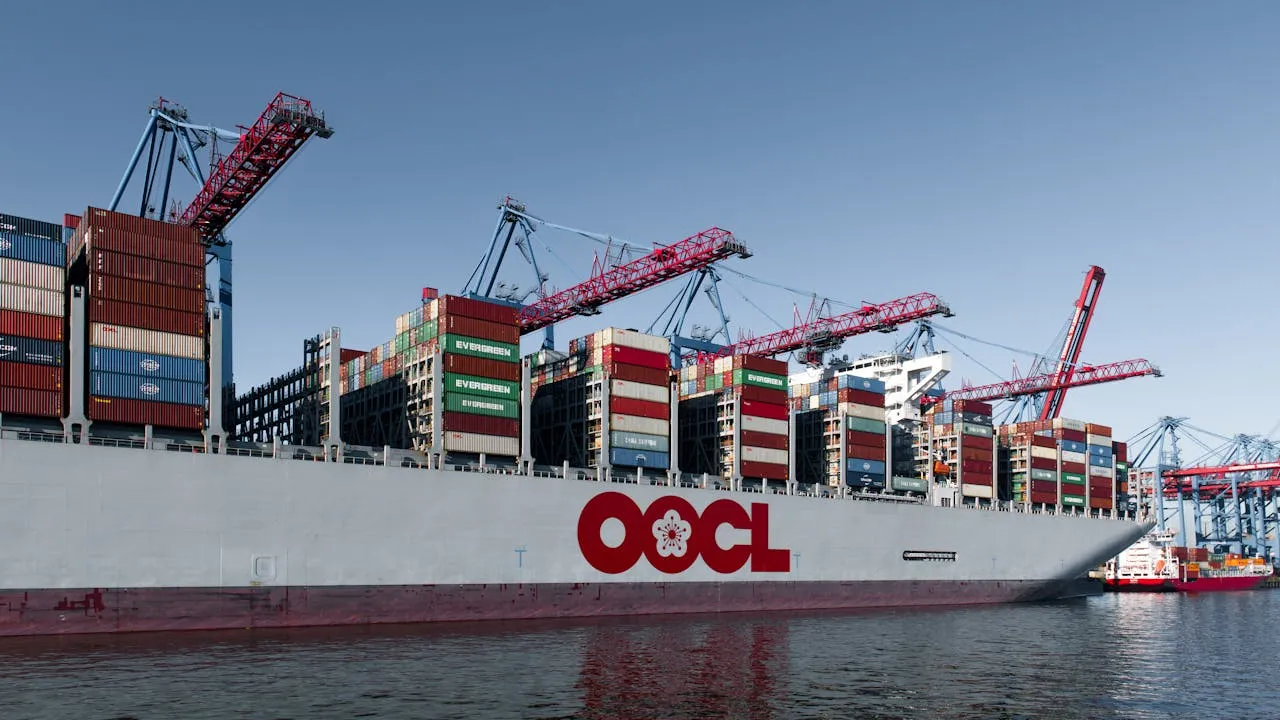
Orient Overseas Container Line Ltd. (OOCL) has announced a major fleet investment with the order of twelve new 13,600 twenty-foot equivalent unit (TEU) class container vessels powered by liquefied natural gas (LNG) dual-fuel propulsion systems. The move marks a significant milestone in the company’s long-term strategy to strengthen operational competitiveness while accelerating its transition toward lower-carbon shipping solutions.
The newbuilding program represents one of OOCL’s most notable investments in sustainable maritime transportation to date. Through this order, the company aims to modernize its fleet, enhance service flexibility, and position itself to meet increasingly stringent environmental regulations shaping the global shipping industry.
According to the company, OOCL formally signed shipbuilding agreements with Hudong-Zhonghua Shipbuilding (Group) Co., Ltd. on April 29, 2026, for the construction of the twelve vessels. Once delivered, these ships will become the first LNG-powered vessels to enter OOCL’s fleet, signaling a major evolution in the carrier’s vessel technology strategy and its approach to future fuel adoption.
The shipping industry is currently undergoing one of the most significant transformations in its history, driven by regulatory pressure, environmental commitments, and rising demand from customers for cleaner transportation solutions. International shipping companies are increasingly being required to reduce greenhouse gas emissions and improve energy efficiency as global decarbonization targets become more ambitious.
Against this backdrop, OOCL’s decision to invest in LNG dual-fuel container ships reflects both market realities and strategic foresight.
The newly ordered vessels will be fitted with advanced dual-fuel main engine systems capable of operating on either LNG or conventional marine fuel. This dual-fuel capability provides flexibility in fuel sourcing and operational planning, while also enabling the vessels to significantly reduce emissions compared with traditional fuel-powered ships.
By utilizing LNG as a primary fuel option, the vessels are expected to achieve meaningful reductions in sulfur oxides, nitrogen oxides, particulate matter, and carbon dioxide emissions. While LNG is viewed as a transitional fuel rather than a final decarbonization solution, it currently remains one of the most commercially viable lower-emission alternatives available for large-scale deep-sea shipping operations.
For OOCL, introducing LNG-powered vessels is more than a technical upgrade—it represents a broader strategic commitment to environmental responsibility and long-term fleet resilience.
The maritime sector is facing increasing regulatory scrutiny from international organizations and regional authorities focused on emissions reduction.
Measures introduced by the International Maritime Organization (IMO), along with emerging regional frameworks such as the European Union’s maritime emissions regulations, are reshaping investment decisions across global shipping fleets. Shipping operators are being pushed to adopt cleaner technologies, improve vessel efficiency, and prepare for future carbon pricing mechanisms.
OOCL indicated that its decision to order LNG dual-fuel ships came after conducting a detailed assessment of environmental regulatory developments, energy transition pathways, technological readiness, and fuel supply infrastructure.
This comprehensive evaluation underscores the complexity of vessel investment decisions in today’s shipping environment. Selecting the right propulsion technology requires balancing environmental performance, commercial viability, infrastructure availability, and long-term adaptability.
By choosing LNG dual-fuel propulsion, OOCL is positioning itself to remain compliant with evolving regulations while maintaining operational flexibility in uncertain energy markets.
The construction of the twelve vessels has been entrusted to Hudong-Zhonghua Shipbuilding (Group) Co., Ltd., one of China’s leading shipbuilders and a recognized player in LNG vessel construction and advanced maritime engineering.
Hudong-Zhonghua has built a strong reputation for delivering technologically advanced vessels, including LNG carriers, container ships, and other specialized maritime assets. Its expertise in integrating LNG propulsion systems and energy-efficient vessel designs makes it a strategic partner for OOCL’s fleet expansion plans.
The collaboration also reflects the growing role of Chinese shipyards in supporting the global maritime industry’s energy transition.
As demand for alternative-fuel vessels rises worldwide, shipbuilders with proven LNG engineering capabilities have become increasingly important partners for container shipping operators seeking to modernize their fleets.
The construction schedule and delivery timeline for the vessels were not immediately disclosed, but the newbuild program is expected to support OOCL’s medium- to long-term operational growth objectives.
One of the most significant aspects of the order is that these vessels will be the first LNG-powered ships in OOCL’s operational fleet.
This marks a historic milestone for the company, which has traditionally operated conventionally fueled container vessels.
The introduction of LNG propulsion technology represents a major operational and organizational transition. Beyond vessel acquisition, integrating LNG-powered ships requires new operational procedures, crew training, maintenance protocols, and fuel supply planning.
OOCL’s decision demonstrates confidence in LNG’s role as an important transitional marine fuel and highlights the company’s readiness to adapt to evolving industry standards.
The addition of LNG-powered ships also enhances OOCL’s ability to serve customers who increasingly prioritize environmental performance in their supply chain decisions.
Many multinational cargo owners and logistics providers now include emissions performance as a key factor when selecting shipping partners. By investing in lower-emission vessel technology, OOCL can strengthen its competitiveness in sustainability-focused market segments.
Commenting on the new vessel order, OOCL Chief Executive Officer Tao Weidong emphasized the strategic significance of the investment.
He stated that the order of twelve 13,600 TEU class LNG dual-fuel container vessels demonstrates OOCL’s commitment to supporting the shipping industry’s green transformation while maintaining flexibility in vessel deployment and fleet diversification.
Fleet diversification has become increasingly important in today’s global shipping environment.
Trade patterns are shifting due to geopolitical developments, supply chain reconfiguration, changing consumer demand, and regional economic growth. Shipping lines must maintain the ability to adjust vessel deployment across different routes and market conditions.
The addition of twelve mid-to-large capacity vessels will provide OOCL with greater flexibility in balancing its network strategy across major trade lanes and emerging regional opportunities.
The 13,600 TEU vessel size is particularly well suited for a range of global routes, offering strong economies of scale while retaining flexibility for deployment across multiple service networks.
This makes the ships suitable for both traditional East-West trade lanes and expanding regional markets where cargo volumes continue to grow.
A key objective of the new vessel order is to support OOCL’s growth ambitions in emerging markets, regional trade corridors, and third-country markets.
As global trade patterns continue to evolve, many shipping companies are expanding beyond traditional trans-Pacific and Asia-Europe routes to capture growth in Southeast Asia, South Asia, Latin America, the Middle East, and Africa.
These regions are experiencing rising manufacturing activity, infrastructure development, consumer demand, and intra-regional trade growth.
OOCL’s increased capacity will allow the company to strengthen its presence in these markets while optimizing service frequency, cargo availability, and operational efficiency.
The company believes that expanding vessel capacity will improve its ability to allocate resources across global trade networks and achieve more balanced long-term growth.
This strategic approach may also help mitigate market volatility by reducing overdependence on a limited number of trade lanes.
Global customers are increasingly seeking shipping partners that can offer not only competitive freight services but also long-term reliability, network flexibility, and sustainability performance.
OOCL’s fleet expansion is designed to meet these evolving customer expectations.
By adding modern LNG dual-fuel vessels, the company aims to provide customers with enhanced service reliability, improved environmental performance, and greater route coverage.
The larger and more fuel-efficient vessels may also contribute to operational cost efficiencies over time, helping the company remain competitive in an industry characterized by fluctuating freight rates, fuel costs, and market cycles.
Tao Weidong noted that the continuous growth in fleet capacity would enable OOCL to better serve customers’ diverse and long-term transportation needs.
This customer-focused strategy aligns with broader industry trends, where shipping lines are increasingly integrating sustainability, digitalization, and network optimization into their long-term business models.
The shipping industry remains in the early stages of its energy transition, with multiple alternative fuels—including LNG, methanol, ammonia, hydrogen, and biofuels—being evaluated for long-term scalability.
While no single fuel pathway has yet emerged as the definitive solution, LNG is currently viewed as a practical transitional option due to its established infrastructure and immediate emissions benefits.
OOCL’s investment in LNG dual-fuel vessels demonstrates a balanced approach to navigating this uncertainty.
By adopting proven lower-emission technology while retaining the flexibility to use conventional fuel when necessary, the company is creating a bridge toward future fuel transitions.
At the same time, the order reflects confidence in global container shipping’s long-term growth potential.
As international trade continues to evolve and supply chains become increasingly interconnected, shipping lines with modern, efficient, and environmentally responsible fleets will be better positioned to capture new opportunities.
For OOCL, the twelve-vessel order is not simply an expansion project—it is a strategic investment in operational excellence, environmental responsibility, and future competitiveness.
With the introduction of its first LNG-powered ships, the company is taking a decisive step toward a cleaner, more flexible, and more resilient future in global maritime transportation.
Source link: https://www.oocl.com/