


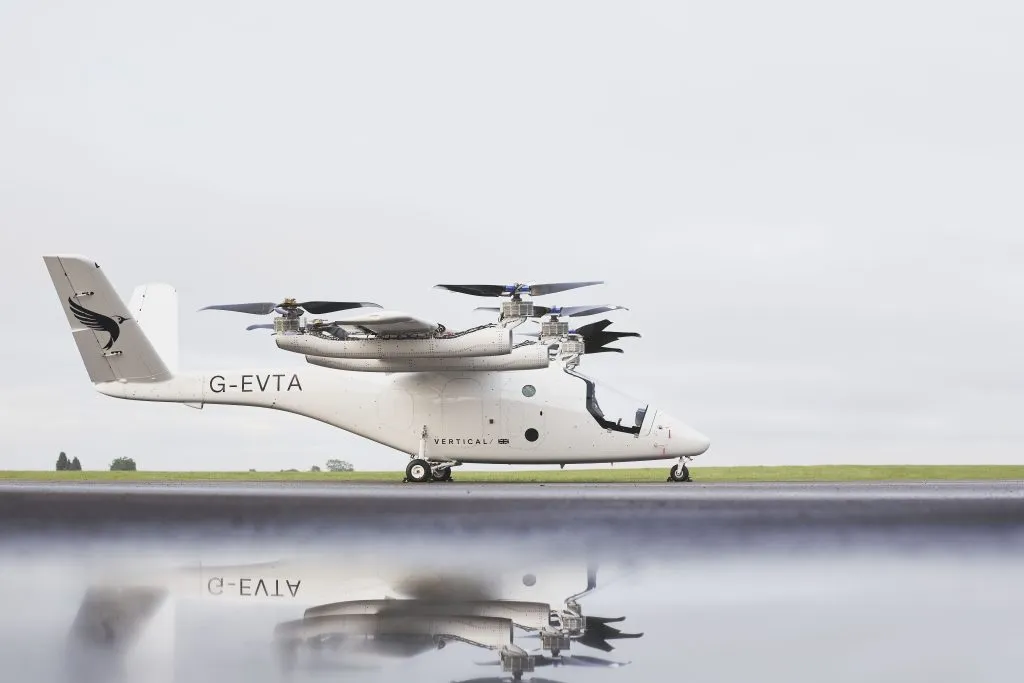
Vertical Aerospace, a global aerospace and technology company focused on the development of electric aviation solutions, has reached another significant milestone in its journey toward commercializing advanced air mobility. The company announced that its newest full-scale prototype aircraft has successfully completed its maiden piloted flight at the Vertical Flight Test Centre in the United Kingdom, marking the beginning of an expanded flight testing campaign designed to accelerate aircraft development, certification efforts, and future commercial deployment.
The successful flight represents an important achievement for Vertical Aerospace as it continues to advance the development of its next-generation electric vertical takeoff and landing (eVTOL) aircraft, known as the Valo. By adding a new aircraft to its growing flight test fleet, the company is increasing its ability to gather critical flight data, validate aircraft systems, and support the certification process with aviation regulators.
The latest prototype took to the skies following extensive preparation, including a rigorous series of ground tests and validation exercises designed to ensure aircraft readiness and safety. The flight was conducted after the UK Civil Aviation Authority (CAA) issued a new Permit to Fly, allowing the aircraft to begin its flight testing program.
The milestone flight took place at 8:49 BST on June 5, 2026, and was piloted by Vertical Aerospace Test Pilot Paul Stone. The successful operation demonstrated the aircraft’s readiness to move into the next phase of development and provided engineers with valuable real-world operational data.
While the newly introduced aircraft begins its testing journey, Vertical’s existing prototype continues to make progress in its own development program. That aircraft has already completed multiple piloted transition flights, demonstrating its capability to move between vertical lift and conventional wing-borne flight modes. Transition flight remains one of the most technically challenging phases of eVTOL operations and is considered a critical step toward eventual certification.
The addition of another prototype significantly expands Vertical Aerospace’s testing capabilities, allowing multiple flight activities to be conducted simultaneously and reducing the time required to validate key systems and performance characteristics.
The latest aircraft is particularly important because it is expected to be the final prototype added to Vertical Aerospace’s flight test fleet before the company completes its Critical Design Review (CDR), one of the most important milestones in aircraft development.
Critical Design Review serves as the formal process through which the company confirms and freezes the design configuration that will be used for certification and production. During this stage, engineers evaluate every aspect of the aircraft, ensuring that systems, structures, software, avionics, propulsion technologies, and safety features meet design requirements and certification objectives.
Achieving CDR effectively establishes the design baseline that regulators and certification authorities will assess as part of the approval process. It also allows the company to move confidently toward manufacturing activities and production planning.
By introducing a second full-scale aircraft into flight testing before reaching this milestone, Vertical Aerospace gains additional opportunities to validate engineering assumptions, verify system performance, and identify any required refinements before finalizing the design.
The increased testing capacity is expected to accelerate development timelines while reducing program risk through expanded real-world operational evaluation.
Certification remains one of the most critical objectives for every eVTOL developer. Regulatory approval requires extensive evidence demonstrating that an aircraft can operate safely and reliably across a wide range of conditions.
Vertical Aerospace’s flight testing program plays a central role in achieving that objective. Through piloted flights and extensive system evaluations, engineers are able to gather the data necessary to support certification submissions and regulatory reviews.
According to the company, expanding the flight test fleet allows for a faster accumulation of flight hours and operational experience. This increased testing activity helps verify aircraft behavior, validate flight control systems, and confirm performance predictions generated through simulation and engineering analysis.
Chief Executive Officer Stuart Simpson emphasized the importance of the milestone, highlighting how additional flight testing capability will accelerate learning and support progress toward commercial operations.
He noted that placing the latest prototype into active flight testing enables the company to collect more real-world data, validate technologies more rapidly, and continue building momentum toward certification. Simpson also stressed that expanding the flight test fleet will help reduce development risk while improving the efficiency of the certification process.
The company believes that accelerating testing activities today will contribute significantly to shortening the path toward bringing the Valo aircraft into commercial service.
In addition to supporting certification activities, the new prototype will play an important role in public demonstrations and stakeholder engagement initiatives.
As interest in advanced air mobility continues to grow globally, demonstrations provide an opportunity for regulators, customers, investors, infrastructure providers, and government agencies to observe aircraft capabilities firsthand.
The increased availability of flight-test aircraft allows Vertical Aerospace to conduct more demonstration events while maintaining ongoing development activities. This flexibility is particularly valuable as the company seeks to build confidence among potential operators and commercial partners.
Demonstration flights also provide an opportunity to showcase the benefits of electric aviation, including reduced noise levels, lower emissions, and the potential for more efficient regional transportation networks.
As governments and transportation authorities worldwide explore sustainable mobility solutions, public demonstrations are expected to play a growing role in helping stakeholders understand the practical applications of eVTOL technology.
One of the most notable aspects of Vertical Aerospace’s strategy involves the future conversion of the newly introduced prototype into a hybrid-electric aircraft.
The company announced that once all planned flight testing phases have been completed in the aircraft’s all-electric configuration, it intends to retrofit the aircraft for hybrid-electric flight testing.
This future development effort reflects growing industry interest in expanding the operational capabilities of advanced air mobility platforms beyond purely electric applications.
Hybrid-electric systems combine battery-powered propulsion with additional onboard power-generation capability, potentially extending aircraft range and increasing payload capacity. Such capabilities could open new opportunities across several sectors where operational requirements exceed the limitations of current battery technologies.
Vertical Aerospace believes hybrid-electric variants could support missions in defense, logistics, cargo transportation, emergency response, and other commercial markets requiring greater endurance and operational flexibility.
The company’s decision to explore hybrid-electric configurations demonstrates a broader strategy aimed at addressing diverse customer requirements while maintaining a commitment to sustainable aviation technologies.
As battery technology continues to evolve, hybrid systems may serve as an important bridge between current electric aircraft capabilities and future long-range zero-emission operations.
The newly introduced aircraft shares the same configuration as Vertical Aerospace’s current full-scale prototype, which has already successfully completed all major phases of flight testing.
These phases include thrust-borne flight, wing-borne flight, and transition flight operations. Together, these testing stages allow engineers to evaluate aircraft performance throughout the entire flight envelope.
Thrust-borne flight focuses on vertical takeoff, hover, and low-speed operations where propulsion systems provide lift directly. Wing-borne flight evaluates aircraft performance during conventional forward flight, where aerodynamic lift generated by the wings becomes the primary source of support.
Transition flight, which bridges these two operating modes, remains among the most technically demanding aspects of eVTOL development. Successfully completing transition flights demonstrates the aircraft’s ability to move smoothly and safely between vertical and horizontal flight configurations.
Because the new prototype shares the same design architecture and systems as the existing aircraft, Vertical Aerospace can efficiently leverage previous testing experience while expanding data collection activities.
This approach allows the company to validate technologies under a wider range of operating conditions while maintaining consistency across its development program.
Following completion of the Critical Design Review, Vertical Aerospace plans to begin preparations for assembling its first pre-production aircraft.
Pre-production aircraft represent an important step between prototype development and full-scale manufacturing. These aircraft are typically built using production-intent processes, materials, and systems and serve as the foundation for final certification activities.
The transition from prototype testing to pre-production assembly signals increasing maturity within the aircraft development program. It also demonstrates the company’s confidence in the progress achieved through engineering, testing, and regulatory engagement.
As the aviation industry moves toward the introduction of advanced air mobility services, successful completion of pre-production activities will position Vertical Aerospace to move closer to commercial operations.
The successful first piloted flight of Vertical Aerospace’s latest full-scale prototype represents more than a single testing milestone. It reflects years of engineering development, regulatory collaboration, and technological innovation aimed at transforming how people and goods move in the future.
By expanding its flight test fleet, accelerating certification activities, and preparing for future production aircraft assembly, the company is steadily progressing toward commercialization of its Valo eVTOL platform.
The addition of a second active prototype strengthens Vertical Aerospace’s ability to validate technologies, gather operational data, and demonstrate aircraft capabilities to regulators and potential customers. At the same time, plans for future hybrid-electric testing indicate a long-term vision that extends beyond current electric aviation capabilities.
As advanced air mobility continues to evolve, milestones such as this maiden piloted flight bring the industry closer to a future where electric and hybrid-electric aircraft become a practical part of global transportation networks. For Vertical Aerospace, the achievement marks another important step on the path toward certification, commercial service, and the broader adoption of sustainable aviation technologies.
Source link: https://www.businesswire.com/